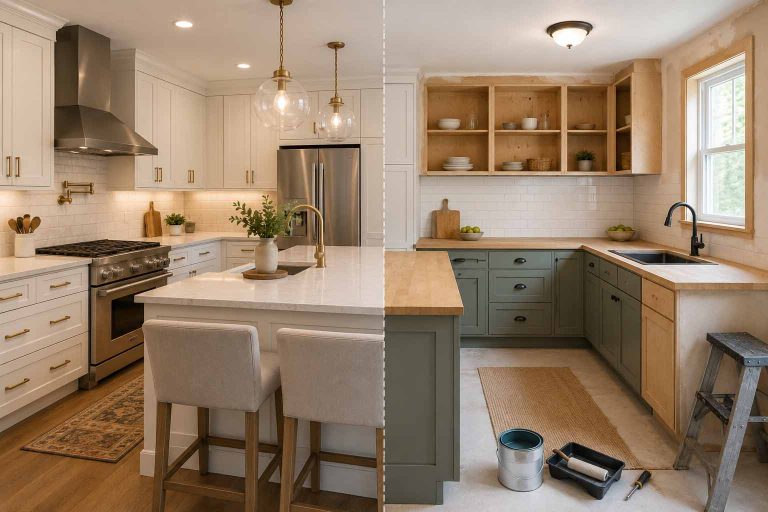
The assumption that adding value to a home requires a major renovation project — a kitchen gut, a bathroom overhaul, an extension — is one of the most expensive misconceptions in home ownership. It leads people to either overspend on projects that return less than they cost, or to do nothing because the perceived investment seems too large.
The reality the data consistently shows is more useful: minor, strategic improvements almost always outperform gut renovations in return on investment. Some of the cheapest upgrades deliver the highest percentage returns. And many of the changes that most influence how a home is perceived — by appraisers, by buyers, and by you every time you pull into the driveway — cost a fraction of what homeowners assume.
This guide covers the upgrades that genuinely move the needle on home value without requiring a contractor on-site for weeks or a budget in the tens of thousands. Whether you’re preparing to sell, refinancing, or simply protecting and building equity over time, these are the changes worth prioritising.
Why minor improvements often beat major renovations on ROI
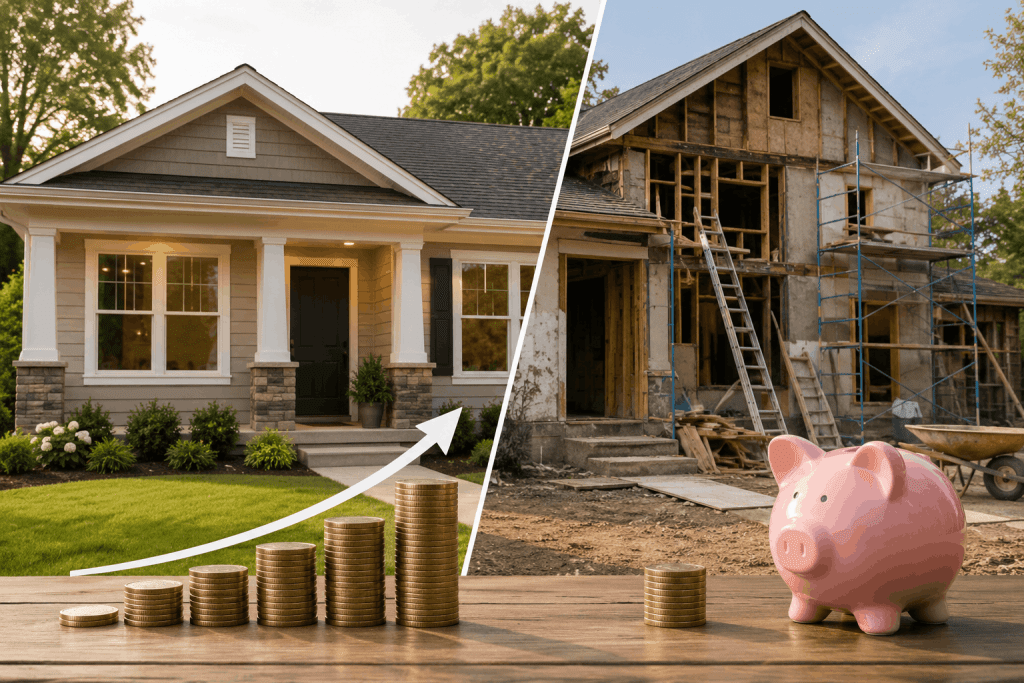
Before getting into specifics, it helps to understand why this counterintuitive pattern holds up so consistently in the data.
Major renovations — full kitchen remodels, primary bathroom overhauls, additions — carry high costs, long timelines, and significant disruption. They also carry a ceiling: there’s a limit to how much any particular market will pay for a kitchen, regardless of how premium the finishes are. When the cost of the renovation exceeds what the market will pay in added value, the ROI falls below 100%. A high-end kitchen remodel might only recoup around 68% of its cost at resale.
Minor improvements work differently. They’re often closing a gap — between what a home looks like and what it should look like given its condition and location — rather than adding premium features above the market ceiling. Closing that gap produces outsized returns because the improvement cost is modest but the perceived value gain is significant.
Curb appeal projects offer some of the highest returns of any home improvement category, frequently yielding over 100% ROI — while major kitchen remodels typically recoup around 68%. That’s a consistent, meaningful reversal of what most homeowners assume.
A useful planning framework is the 30% rule: a remodeling budget shouldn’t exceed 30% of what you’d expect the home to sell for. Within that constraint, the projects that add the most value are almost always the ones that improve how the home presents — not the ones that replace functional systems with premium versions.
Start outside: the case for curb appeal first
The exterior of your home sets expectations before anyone opens the front door. Appraisers begin their assessment before they even turn off the engine. Buyers form opinions within seconds. And you see your home’s exterior every single day — which means its condition affects how you feel about where you live, not just what it might sell for.
When you neglect the face of your home, you signal to the appraiser that major structural components may also be failing. A well-maintained exterior, by contrast, suggests a well-maintained home overall — which directly influences condition ratings, effective age assessments, and comparable selection during an appraisal.
Garage door: the highest ROI project in home improvement
This surprises almost everyone, but the data is unambiguous. According to the latest cost-versus-value data, a garage door replacement tops the list of high-ROI projects nationwide — recouping well over 100% of costs at resale in many markets. Standard landscaping and lawn care upgrades often yield over 200% cost recovery, while exterior painting and garage door replacements consistently top the charts for value added relative to investment.
The reason is simple geometry. In most homes, the garage door takes up 30% or more of the visible facade — and it is almost always the most neglected surface. An old, mismatched, or dented garage door quietly drags down everything around it. A clean, well-designed door can instantly make a property look modern and well-maintained.
Modern insulated garage doors also offer a functional benefit beyond appearance: polyurethane insulation helps stabilise the temperature of the garage and adjacent spaces, reducing HVAC strain and lowering utility bills — a selling point with measurable monthly value.
If a full replacement is out of budget, a professional service and repaint of an existing door that’s structurally sound produces meaningful results at a fraction of the replacement cost.
Front door: maximum impact for minimum investment
Painting the front door is probably the single highest return-per-hour task available in home improvement. It requires no special skills, costs very little, can be completed in a few hours, and makes an immediate noticeable difference to how your entire home presents.
The colour choice matters. In 2026, deep greens, navy blues, warm blacks, and bold reds consistently outperform dated earth tones and standard white in both buyer perception surveys and real estate photography. A bold, well-chosen front door colour on a neutral exterior creates a focal point that makes the home memorable — which matters more than most homeowners realise during a competitive sale.
If the door itself is old, warped, or damaged, a mid-range steel replacement door delivers strong resale value because it improves curb appeal and signals a well-maintained home. Even a mid-range entry door — thoughtfully selected — can deliver a solid return without the expense of a large remodel.
Update door hardware at the same time: a new handle set, a modern knocker or house numbers in a consistent finish (matte black, brushed brass, or satin nickel all work well), and an exterior light fixture that complements the door. The total cost of this combination — paint, hardware, new fixture — is typically under $500 and produces a change that looks like a $5,000 exterior update.
Exterior paint and power washing
A fresh coat of exterior paint can recoup 100% or more of its cost, according to HomeLight agent surveys. A professional exterior paint job typically runs $3,000–$7,000 and instantly eliminates the single most visible sign of deferred maintenance.
If a full repaint is premature or out of budget, power washing the exterior surfaces — siding, brick, driveway, walkways, and fence — removes the years of dirt, algae, and mildew accumulation that makes a maintained home look neglected. A pressure wash of the exterior costs $200 to $500 professionally and produces a result that reads as significantly fresher without changing a single surface.
Painting the front door can add brightness and improve the look of a home’s entryway. Most exterior paint costs between $30 and $40 per gallon, making a DIY front door repaint one of the most affordable improvements available to any homeowner.
Landscaping: not as expensive or complicated as you think
Landscaping is the biggest bang for the buck — 82% of homeowners rate it as a major improvement to curb appeal. But meaningful landscaping improvement doesn’t require a landscape designer or significant planting investment.
The high-impact, low-cost approach:
Mulch. Fresh mulch in garden beds is one of the most visually transformative low-cost exterior improvements. A single truckload spread across beds instantly makes plantings look intentional and well-maintained, eliminates the bare-dirt look that photographs poorly, and suppresses weeds. Cost: $200 to $500.
Edge the lawn. Clean, crisp edges along driveways, walkways, and garden beds signal meticulous maintenance even if nothing else has changed. Renting an edger for a half-day costs under $50.
Trim and tidy. Overgrown landscaping is one of the biggest curb appeal negatives — 81% of homeowners in surveys rate it as a significant detractor. Trimming existing shrubs and trees, removing dead growth, and cleaning up debris costs almost nothing and addresses one of the most common curb appeal problems.
Plant one focal element. A statement plant at the front entry — a boxwood, a small ornamental grass, a flowering shrub — creates intentionality and draws the eye in the right direction. Native plants suited to your local climate require less maintenance and look more naturally at home than imported species.
Inside the home: high-return interior improvements
Paint: the single most impactful interior change
Fresh interior paint is the interior equivalent of the exterior mulch — it makes everything look cleaner, newer, and more cared-for, and it photographs dramatically better than aged, scuffed, or dated paint colours.
In 2026, the palette that performs best in real estate contexts is warm neutrals: warm whites, creams, soft beiges, and light greiges. These colours photograph well in every light condition, read as clean and spacious, and don’t impose a colour preference that makes a buyer feel they’d need to repaint before moving in. Avoid strong whites (they read cold in photographs) and any colour that reads as a personal choice rather than a neutral backdrop.
Painting a home’s interior before listing consistently appears in agent surveys as one of the most recommended pre-sale improvements. As a DIY project, the materials cost for an average three-bedroom home is $400 to $800. Hired out professionally, it runs $2,000 to $5,000 — still among the best investments available per dollar spent.
Hardware and fixtures: the detail-level transformation
Cabinet hardware, light fixtures, plumbing fixtures, and door hardware are the details that signal how current and well-maintained a home is to anyone who looks carefully. Updating these costs far less than replacing the underlying cabinets or plumbing, and produces a result that reads as a higher-quality renovation than it actually represents.
Cabinet hardware. Replacing kitchen and bathroom cabinet handles and pulls is a two-hour project with a screwdriver. The materials cost for a full kitchen is typically $200 to $500 depending on the number of cabinets and the hardware selected. The visual difference between dated brass builder hardware and consistent matte black or brushed nickel hardware on the same cabinets is substantial.
Light fixtures. Builder-grade flush-mount fixtures are in most of the homes built between 1990 and 2015, and they photograph as cheap and dated even in otherwise well-maintained rooms. Replacing them with pendant lights in living areas, a statement fixture in the dining room, and sconces in bathrooms costs $150 to $400 per fixture and produces a change that reads as a deliberate design choice rather than a builder’s default. Under-cabinet LED lighting in the kitchen — around $150 to $400 for a full kitchen — adds both visual warmth and functional task lighting.
Plumbing fixtures. A dated faucet on an otherwise nice vanity or kitchen sink drags the perception of both down. Mid-range faucet replacements ($100 to $400) can be done DIY with basic plumbing knowledge and make bathroom and kitchen fixtures read as current.
Deep cleaning: not glamorous, but genuinely impactful
A professionally deep-cleaned home shows better than a home with higher-quality finishes that hasn’t been thoroughly cleaned. Clean is the most fundamental signal of maintenance, and it’s the signal appraisers and buyers read most reliably.
A professional deep clean before any showing or appraisal — including oven interior, refrigerator, grout lines, bathroom caulking, and light fixtures — costs $200 to $500 for a typical home and produces a result that no amount of renovation compensates for when absent.
This isn’t just a pre-sale strategy. A consistently well-maintained home — cleaned thoroughly on a regular schedule — shows a lower effective age to appraisers than a home that’s been renovated but clearly neglected in day-to-day care.
Flooring: refresh rather than replace where possible
Floors are among the most expensive items to replace and among the highest-impact surfaces in how a home reads. Before replacing flooring, assess what’s possible with restoration.
Hardwood refinishing at $3 to $5 per square foot produces a result that is genuinely difficult to distinguish from new hardwood installation at $10 to $20 per square foot. If the existing hardwood is solid, refinishing is almost always the better investment.
Carpet deep cleaning at $150 to $400 professionally removes embedded dirt and odours that make carpet look more worn than it is. This is worth doing before any assessment, regardless of whether carpet replacement is on the table.
Tile grout restoration — cleaning and resealing grout in kitchens and bathrooms — addresses one of the most common reasons these rooms look dated without touching the tile itself.
If flooring genuinely needs replacing, quality LVP in a wood-look finish is the most cost-effective choice for broad appeal and durability. It installs over existing floors in many cases (eliminating subfloor preparation costs), photographs well, and is the most renter- and buyer-friendly option for broad demographic appeal.
Energy efficiency: value that shows up monthly and at sale
Energy-efficient improvements add value in two ways: they reduce ongoing utility costs in a way buyers will notice when reviewing utility history, and they address what buyers increasingly cite as a purchase priority.
Attic insulation is among the best-performing improvements by ROI. Insufficient attic insulation is one of the most common causes of high heating and cooling costs in homes built before 2000. Improving attic insulation to current standards costs $1,500 to $4,000 for most homes and reduces heating and cooling costs by 15% to 30%, with near-100% ROI when factored into reduced utility costs at sale.
Smart thermostat. A programmable smart thermostat costs $150 to $300 installed and appeals strongly to the significant portion of buyers who now expect smart home features as a baseline. Paired with documentation of lower utility bills, it’s a talking point that costs almost nothing relative to its perceived value.
Window weatherstripping and sealing. Before replacing windows (which rarely delivers strong ROI), ensure existing windows are properly sealed. Air sealing around windows and doors can reduce energy loss significantly at a cost of $50 to $200 in materials for a full home.
Decluttering: the free improvement with a real effect
This is the improvement no one wants to talk about because it’s not a purchase — but it consistently appears in agent feedback as one of the most impactful changes before a sale, and it applies equally to day-to-day living quality.
A decluttered home reads as larger, cleaner, and more cared-for than the same home with surfaces covered and storage overflowing. It photographs better, shows better, and gives appraisers the clear view of what they’re assessing. It also allows buyers to visualise their own belongings in the space rather than navigating around yours.
The process: work room by room, and apply a simple rule to each object — does this item belong in this home, or is it here because it hasn’t been dealt with? Items that don’t have a clear function and a designated place in the home are either stored off-site, donated, or discarded. This isn’t minimalism for its own sake; it’s creating enough visual breathing room that the home’s actual qualities — space, light, finishes — can be perceived clearly.
What not to spend on
The improvements that look significant but consistently underperform in ROI are worth naming explicitly, because the marketing around home improvement tends to oversell them.
Luxury kitchen overhauls on homes in average markets. The market has a ceiling for kitchen quality, and spending above it doesn’t return the investment.
Swimming pools. Pools add cost and liability in most markets and appeal to a narrower pool of buyers than the investment requires. In hot climates with strong outdoor culture, the calculus is different — but in most markets, pool installation delivers very poor ROI.
Home additions that take the home significantly above the neighbourhood’s average size. Buying the smallest house on the best street is good strategy. Building the largest house on an average street is the inverse, and the premium doesn’t recover because comparable sales in the neighbourhood don’t support it.
Highly personalised finishes. Bold wallpaper, unusual tile choices, and distinctly personal design directions may add genuine joy to living in the home. They don’t add value at sale — they reduce the pool of buyers who will see the home positively.
Prioritising: the sequence that makes sense
If you’re approaching this strategically rather than as a pre-sale sprint, the sequence is:
- Fix deferred maintenance first. A leaking gutter, a damaged soffit, a cracked driveway — these signal neglect to appraisers and buyers regardless of how nice everything else is. Maintenance items are not improvements; they’re the baseline.
- Exterior before interior. First impressions are formed outside, and exterior improvements deliver the highest ROI. Paint the front door, freshen the landscaping, power wash the driveway before touching anything inside.
- Neutral paint throughout. One of the highest-return investments per dollar across the whole interior.
- Hardware and fixture updates. The detail level that makes a recently painted, well-maintained home read as intentionally designed.
- Deep clean. Before any showing, appraisal, or occasion where the home will be seen critically.
- Energy efficiency targeting. Attic insulation and smart thermostat as the highest-ROI efficiency improvements.
The summary: what actually moves home value
| Improvement | Approx. cost | ROI profile |
|---|---|---|
| Garage door replacement | $1,500–$4,000 | Often exceeds 100% |
| Exterior paint (professional) | $3,000–$7,000 | 100%+ per agent surveys |
| Front door paint + hardware | $200–$500 | Very high per dollar |
| Landscaping refresh (mulch, trim, tidy) | $300–$800 | Among highest % returns |
| Interior paint (DIY or pro) | $400–$5,000 | Consistently recommended pre-sale |
| Cabinet hardware replacement | $200–$500 | Very high per dollar |
| Light fixture updates | $150–$400 per fixture | High per dollar |
| Attic insulation | $1,500–$4,000 | Near 100%, plus ongoing savings |
| Smart thermostat | $150–$300 installed | Strong for buyer appeal |
| Hardwood floor refinishing | $3–$5 per sq ft | Much better ROI than replacement |
| Decluttering | Free | Significant perceived value gain |
The bottom line
Adding meaningful value to a home doesn’t require a major renovation. It requires understanding where perceived value comes from — and the answer, consistently, is from how the home presents, not from how premium its underlying systems are.
A home that’s clean, well-maintained, freshly painted inside and out, with updated hardware and fixtures, a well-chosen front door colour, and tidy landscaping will outperform a home with a renovated kitchen but peeling exterior paint, dated fixtures, and an old garage door.
The improvements that move the needle most reliably are also, somewhat counterintuitively, among the least expensive. Start at the street, work your way in, and focus on the presentation layer — the surfaces, the details, and the maintenance signals — before anything structural or systemic.
That’s where the return lives.