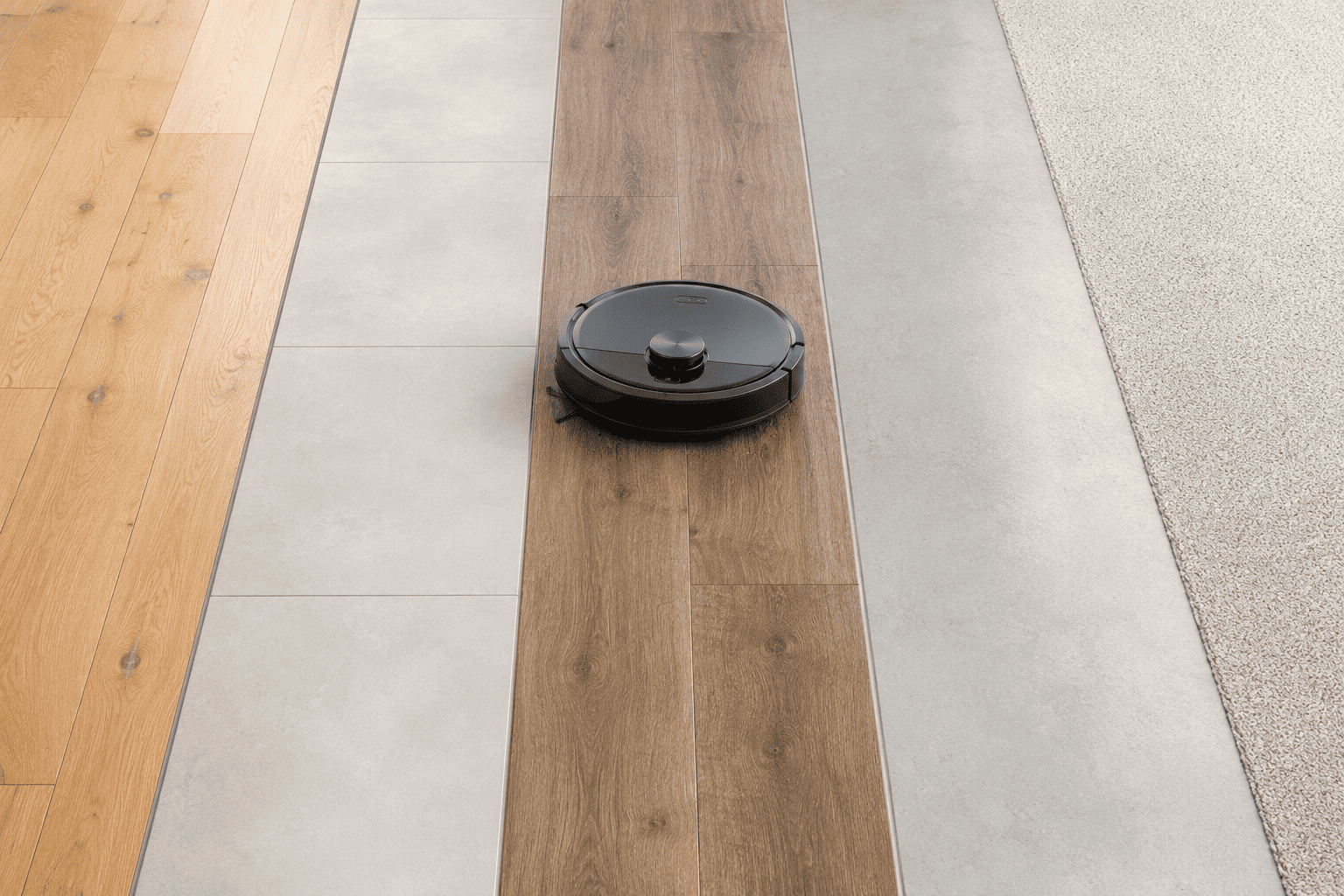
If you already own a robot vacuum, your floor type shapes how well it performs every single day. If you’re choosing flooring for a new home or renovation and you plan to use a robot vacuum, the decision you make now will determine whether automated cleaning is genuinely effortless or a daily source of frustration.
Not all floors are equal partners for a robot vacuum. Some are essentially ideal — the robot glides, cleans thoroughly, and docks without incident. Others create consistent problems: sensors that misread the surface, wheels that can’t navigate transitions, brushrolls that can’t extract embedded debris, or moisture that risks the floor finish. A few specific floor types and configurations actively don’t work well with robot vacuums and are worth knowing about before you commit to them.
This guide covers every major floor type honestly — what robot vacuums do well on each, what the limitations are, what to watch for if you’re buying new flooring, and the configurations that genuinely cause problems.
The four things robot vacuums need from a floor to perform well
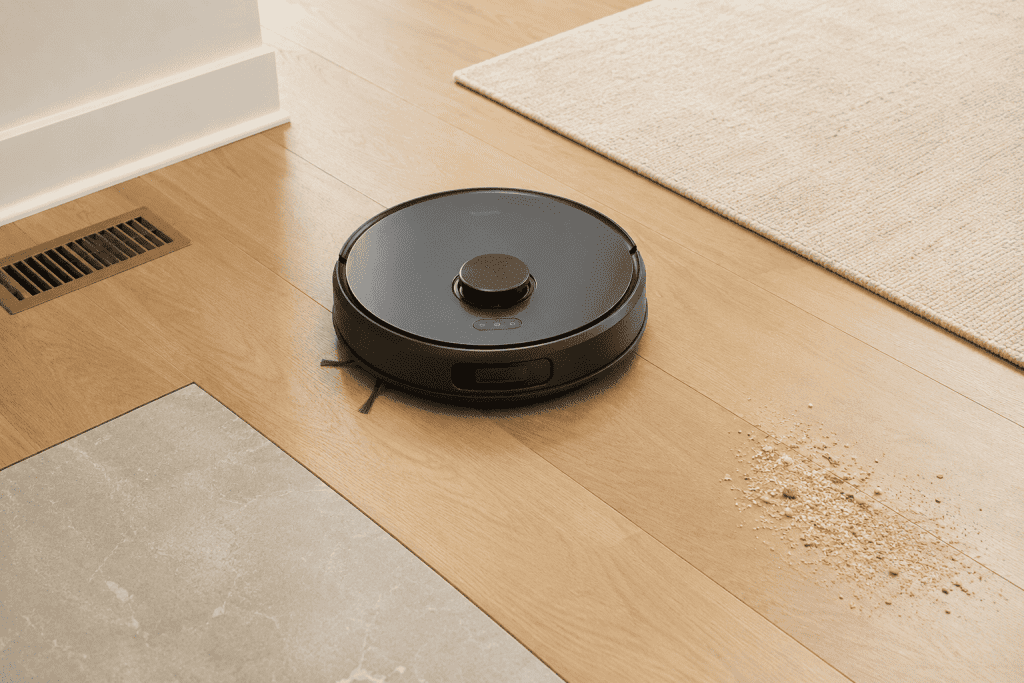
Before going floor by floor, it helps to understand what robot vacuums actually need from a surface to do their job properly.
Consistent, navigable transitions. The robot crosses from room to room, over door thresholds, and between floor types multiple times per run. Transitions that are too tall, too abrupt, or have edges that curl up stop the robot or damage it over time. Most standard robots handle transitions up to about 20mm (0.8 inches) reliably. Anything higher causes consistent stalling.
Surfaces that read correctly to sensors. Cliff sensors on the robot’s underside use infrared light to detect drops. Some floor colours and surface treatments interfere with these sensors, causing the robot to either refuse to enter an area or navigate erratically.
A surface that debris sits on rather than hides in. On smooth hard floors, debris sits on the surface and is easily picked up. On carpet, debris sinks into the pile over time. The deeper it sinks, the more suction and brush agitation the robot needs to extract it.
Moisture compatibility. For robots with mopping functions, the floor must be compatible with light moisture application — sealed, impermeable, and not prone to swelling or warping when briefly dampened.
With these criteria in mind, every floor type becomes easier to evaluate.
Floor types that work excellently with robot vacuums
Luxury vinyl plank (LVP) and luxury vinyl tile (LVT)
LVP and LVT are the best overall floor types for robot vacuum use, full stop. The combination of properties they offer makes automated cleaning almost completely friction-free.
LVP is smooth, hard, and entirely impermeable. Debris sits on the surface rather than embedding in it, making pickup straightforward at any suction level. The surface is consistent and flat, so robot sensors read it accurately every time. The click-lock installation system produces tight seams with no gaps, so moisture from a robot mop has nowhere to penetrate.
Robot vacuums designed for LVP floors use soft rubber wheels that prevent scuffing and scratches, while adjustable suction settings allow the power to be dialled down appropriately for a smooth surface. The gentle cleaning action that protects LVP also happens to be all the floor needs — hard floors require less suction than carpet, and LVP is easy to clean thoroughly without high Pa ratings.
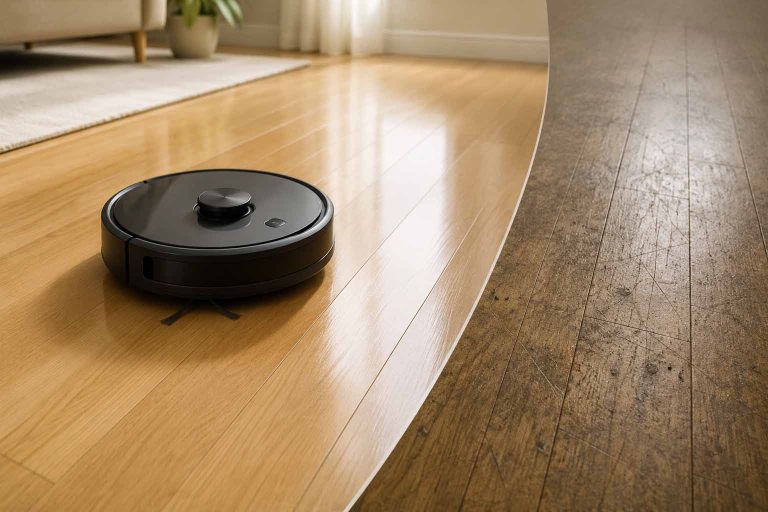
The mopping function works particularly well on LVP. The surface is completely waterproof, accepts light moisture without any risk, and shows cleaning results clearly — a mopped LVP floor has a noticeably cleaner sheen that a vacuum-only pass doesn’t produce. LVP is also the floor type where a robot vacuum mop running daily demonstrates the most visible difference from vacuuming alone.
For mixed-floor homes, LVP is available in realistic wood-look and stone-look designs that compete visually with hardwood and tile at significantly lower cost, making it an ideal flooring choice for anyone prioritising both aesthetics and robot vacuum compatibility.
Robot vacuum performance on LVP: Excellent across all functions — vacuuming, mopping, navigation, and transition handling.
Ceramic and porcelain tile
Ceramic and porcelain tile performs almost as well as LVP for robot vacuum use, with one significant additional benefit: it is the most moisture-resistant surface available, making it the ideal partner for a robot vacuum with mopping capability.
The hard, smooth tile surface is easy to navigate, reads accurately to all sensor types, and allows debris pickup at modest suction levels. The completely impermeable surface means moisture from mopping evaporates cleanly with no penetration risk, and the robot mop can be used at any moisture setting without concern.
The one complexity with tile is grout. Grout lines between tiles are slightly recessed and porous, and debris — particularly fine dust, pet hair, and sand — can settle into grout lines rather than sitting cleanly on the tile surface. A robot vacuum’s brushroll and suction handle most of this, but grout lines do accumulate debris that requires periodic manual attention (a stiff grout brush and appropriate cleaner) in addition to daily robot cleaning. Daily robot runs significantly slow this accumulation by removing surface debris before it can settle into grout, but they don’t eliminate it entirely.
Tile floors need concentrated suction power to lift dust, dirt and pet hair from smooth surfaces and grout crevices. Rubber rollers work best for tiles, as they pick up hair without tangling — bristle brushes can scatter debris on hard surfaces.
Large-format tiles (600mm × 600mm or larger) are particularly good for robot vacuums because they have fewer grout lines — both reducing the maintenance complexity and producing a flatter, more consistent surface for the robot to navigate.
Robot vacuum performance on tile: Excellent. Best surface for robot mopping. Grout requires periodic manual attention.
Hardwood floors (sealed and in good condition)
Sealed hardwood in good condition — a modern polyurethane finish without significant scratches, worn patches, or gaps between planks — works well with robot vacuums. The smooth surface is easy to navigate, debris sits on top rather than embedding, and a light mopping pass enhances the clean substantially.
The important caveat is condition and finish type. Not all hardwood is equally compatible.
Sealed hardwood with an intact polyurethane finish handles robot vacuum mopping safely at the lowest moisture setting. The finish provides a waterproof barrier that prevents the light moisture from a robot mop from penetrating the wood beneath. A simple test confirms whether the seal is intact: a few drops of water on the surface should bead up and sit on top rather than being absorbed into the wood. If water absorbs and darkens the area, the finish is compromised and the mop function should be disabled until the floor is resealed.
Oil-finished and wax-finished hardwood — more common in older homes and with some high-end European flooring brands — is more permeable than polyurethane-sealed floors and should not be mopped with a robot vacuum. These finishes require specific care products and are damaged by the moisture and pH of standard robot mop solutions.
Engineered hardwood behaves similarly to solid hardwood from a robot vacuum standpoint, with slightly better dimensional stability in response to moisture. The real-wood veneer on top responds to the same care requirements as solid hardwood — pH-neutral cleaner, lowest moisture setting, sealed surface only.
Dark hardwood colours are worth a specific note. Some robot vacuums use infrared sensors that may misinterpret darker colours as edges or obstacles, causing the robot to avoid or hesitate at very dark floor surfaces. If your hardwood is very dark — deep ebony, dark walnut, near-black stained floors — test how your specific robot handles it. LiDAR-based navigation handles dark floors better than pure infrared sensor systems.
Robot vacuum performance on hardwood: Very good on sealed floors in good condition. Mopping safe at low moisture settings on intact polyurethane finish. Not suitable for oil/wax finished, unsealed, or significantly worn floors.
Laminate
Laminate flooring performs similarly to LVP for robot vacuum vacuuming, with one additional consideration: moisture sensitivity.
Laminate has a wood-composite core beneath its decorative and wear layers. This core is significantly more moisture-sensitive than LVP’s PVC core. While the surface of laminate is sealed and water-resistant for incidental spills, prolonged moisture exposure — particularly at plank seams and edges — can cause the core to swell, resulting in the edge-peaking and surface bubbling that characterises moisture-damaged laminate.
Robot vacuuming on laminate is entirely safe and works well. Robot mopping on laminate is acceptable on the lowest moisture setting with a quick-drying solution, but should be monitored for any signs of moisture penetration at seams. If the laminate is older, if the seams have any visible gaps, or if the surface coating shows wear, disable the mop function and clean manually with a barely-dampened flat mop.
LVP floor surfaces can get scratched easily by dirt and debris. Using the wrong cleaning tools, such as harsh vacuums or abrasive cleaning products, can damage the surface over time — gentle cleaning methods are important. The same applies to laminate: use the vacuum’s standard mode rather than maximum suction, and ensure the brushroll is soft rubber rather than stiff bristle.
Robot vacuum performance on laminate: Very good for vacuuming. Mopping acceptable with caution — lowest moisture setting, quick-drying solution, sealed seams required.
Floor types that work adequately with important caveats
Low-pile and medium-pile carpet
Low-pile carpet (up to approximately 8mm pile height) is where robot vacuums transition from excellent to good. The robot can navigate it without difficulty, the carpet boost mode increases suction when carpet is detected, and everyday surface debris — crumbs, pet hair, dust — is picked up reliably.
The limitation of low-pile carpet is that embedded debris — fine grit, pet dander, and anything that’s been walked into the pile over several days — requires more suction and brush agitation than a robot vacuum’s daily pass provides. For low-pile carpet, use the robot for daily surface maintenance and supplement with a more powerful upright or stick vacuum used weekly for deeper extraction.
Medium-pile carpet (8–12mm) requires more from the robot: at minimum 5,000–8,000 Pa suction, carpet boost mode, and a strong rubber brushroll. At this pile height, the robot’s wheels begin to sink slightly into the surface, which increases resistance and reduces cleaning coverage per run. Well-specified mid-range and premium robots handle medium-pile carpet competently for daily maintenance; budget robots without carpet boost mode struggle.
Thick pile carpets can be challenging for robot vacuums. Many standard models struggle with deep fibres, reduced suction contact, and getting stuck. High-end models with powerful suction (over 5,000 Pa), strong traction, and height-adjustable brushes perform better.
Robot vacuum performance on low-to-medium carpet: Good for surface maintenance. Weekly deep cleaning with a more powerful machine remains necessary.
Polished concrete and natural stone
Polished concrete and natural stone (marble, travertine, slate) work well for robot vacuum navigation — smooth, consistent, and easy for sensors to read. The cleaning considerations are in the chemistry of any mopping solution used.
Natural stone is acid-sensitive. Vinegar, citrus-based cleaners, and any mildly acidic solution — common in DIY robot mop formulations — can etch stone surfaces over time, dulling the polish and creating microscopic surface damage that accumulates. Only pH-neutral solutions specifically rated for natural stone should be used in a robot mop water tank for homes with stone floors.
Highly polished surfaces also show water spots more readily than matte or satin finishes. The quality of the robot mop’s water delivery — how evenly it applies moisture and how quickly it dries — matters more on polished stone than on LVP or tile.
Polished concrete requires the same pH-neutral approach. Unsealed concrete should not be mopped by a robot.
Robot vacuum performance on natural stone and polished concrete: Good for vacuuming. Mopping requires pH-neutral stone-safe solution only. Unsealed surfaces should not be mopped.
Floor types and configurations that cause problems
High-pile and shag carpet
This is the clearest “approach with realistic expectations” category in the robot vacuum world. High-pile carpet (above approximately 15mm pile height) and shag rugs present two fundamental challenges that specifications and marketing rarely address honestly.
First, the mechanical problem: high-pile rugs, like shag or thick plush carpets, are harder to cross. The fibres can slow down the wheels or lift the vacuum slightly off the ground, reducing traction. The brush may tangle or stop spinning. At extreme pile heights, the robot is essentially trying to drive across a surface that provides no firm traction, while the brushroll is fighting against fibres that are longer than its contact point. Many standard robots simply get stranded on shag rugs.
Second, the cleaning limitation: even if the robot can navigate shag carpet, its suction and brushroll geometry are designed for surfaces where the cleaning head maintains consistent contact with the debris. In long fibres, the cleaning head can’t achieve consistent contact, and debris that’s embedded below the tips of the pile is largely inaccessible.
High-pile or shag rugs generally require stronger suction (10,000–12,000 Pa) and motor torque to avoid getting stuck. High-pile or ultra-plush shag rugs are generally not recommended for robot vacuums, as the long fibres can trap the brushes and limit movement.
Premium robots with adaptive chassis systems — Roborock’s AdaptiLift, Dreame’s ProLeap — handle high-pile carpet better than standard robots, but even these have limits. For dedicated shag rug cleaning, a manual vacuum with a motorised head designed for long-pile use is the appropriate tool.
Practical approach: Set no-go zones around shag rugs and high-pile area rugs in your robot’s app. Vacuum these manually. Let the robot handle the surrounding hard floors or low-pile carpet where it genuinely excels.
Rugs with fringe or tassels
Fringe and tassels are, from a robot vacuum’s perspective, loose threads waiting to be caught. Fringes and tassels are one of the most common causes of robot vacuums getting stuck. Loose ends can get caught in the side brushes or main roller, stopping the vacuum and triggering a cleaning error.
This isn’t a problem that’s solved by a more capable robot — it’s a fundamental interaction between loose fibres and spinning brushrolls. Even premium robots with sophisticated obstacle avoidance don’t reliably detect fringe as an obstacle category, because it looks like floor covering from the robot’s perspective until contact is made.
Practical approach: Tape fringe flat along the rug edge, fold it under the rug permanently, or set a no-go zone in the app that keeps the robot away from fringed edges. The last option is the cleanest solution and takes two minutes to configure.
Very dark or black flooring
Surprisingly, the colour of a rug or floor can affect a robot vacuum’s performance. Some models use infrared sensors that may misinterpret darker colours as edges or obstacles, staying away from them instead of cleaning.
This affects not just dark rugs but very dark hardwood, charcoal-stained concrete, and near-black LVP or tile in certain lighting conditions. The infrared cliff sensors emit light and measure reflection; very dark surfaces absorb rather than reflect infrared, producing a sensor reading that resembles a drop-off.
The practical effect: the robot either refuses to enter dark-floored rooms, turns around at the edge of a dark rug, or navigates erratically in very dark floor areas.
LiDAR-based navigation is significantly less susceptible to this problem than purely infrared-based systems, because LiDAR uses laser pulses that bounce off surfaces regardless of colour. If you have very dark floors or plan to install them, a robot with LiDAR navigation is worth specifically seeking out.
Practical approach: Test your robot in any dark-floored area before setting up an automated schedule. If the robot has a cliff sensor sensitivity adjustment in the app or settings, reduce it. If the problem persists, LiDAR-based navigation is the technical solution.
Unsealed, oiled, waxed, or worn hardwood
Hardwood floors that aren’t in good condition — worn finish with visible bare wood patches, oil or wax finish rather than polyurethane, or original boards with significant gaps between planks — require special handling that limits what a robot vacuum can do on them.
Worn or bare hardwood with no intact finish is vulnerable to moisture. Even a lightly damp mop pad creates moisture exposure the bare wood wasn’t designed to handle. Robot mopping should be disabled entirely on these floors.
Oil-finished hardwood — common in certain high-end and Scandinavian flooring styles — uses a penetrating oil that conditions the wood rather than a surface film. This finish is genuinely incompatible with most floor cleaning solutions and with robot mop moisture. Manual maintenance with the specific oil product recommended by the floor manufacturer is the appropriate care approach.
Hardwood with significant gaps between planks — common in older homes where planks have dried and contracted — allows moisture and debris to fall between planks. A robot vacuum driving over gapped hardwood can push debris into the gaps rather than picking it up, and any mopping adds moisture that settles between planks.
Practical approach: Have worn hardwood resealed with polyurethane before running a robot on it. Disable the mop function on oil-finished floors. Vacuum gapped hardwood on the lowest suction setting to prevent debris being pushed into gaps.
What to consider when choosing new flooring for a robot-vacuum home
If you’re in the position of choosing flooring for a new home or renovation and you plan to rely on a robot vacuum, these are the specification priorities:
Choose LVP as the default for hard floors. It’s the most compatible surface available, the most forgiving of moisture, the easiest to maintain, and available in designs that compete visually with hardwood or tile. It’s also typically more affordable than both alternatives.
Avoid shag or high-pile carpet in rooms where the robot needs to clean. If you want carpet texture, choose low-pile or medium-pile options. These work well with robot vacuums. High-pile carpet works with premium robots at best and strands standard robots.
Choose large-format tiles if you’re installing tile. Fewer grout lines mean less grout maintenance alongside the robot’s daily cleaning.
Avoid very dark floor finishes if budget navigation is a concern. Mid-range and premium LiDAR-based robots handle dark floors reliably. If you’re planning to use a budget robot, neutral or lighter floor tones avoid the cliff sensor confusion problem entirely.
Plan door thresholds for maximum compatibility. New installation is the opportunity to choose transition strips that create gentle, low-profile ramps between floor levels rather than abrupt step changes. Threshold height of 15mm or below is the practical limit for most robots without difficulty.
Quick reference guide
| Floor type | Vacuuming performance | Mopping performance | Key considerations |
|---|---|---|---|
| LVP / LVT | Excellent | Excellent | Best overall robot vacuum floor |
| Porcelain / ceramic tile | Excellent | Excellent | Grout lines need periodic manual cleaning |
| Sealed hardwood | Very good | Good (lowest moisture, pH-neutral) | Test seal integrity; disable mop on oil/wax finish |
| Engineered hardwood | Very good | Good (same as solid hardwood) | Same moisture precautions as solid hardwood |
| Laminate | Very good | Caution (lowest moisture, sealed seams) | Moisture-sensitive core; avoid on worn/gapped laminate |
| Low-pile carpet | Good | N/A | Supplement with weekly deep vacuum |
| Medium-pile carpet | Adequate | N/A | Requires carpet boost + 5,000+ Pa |
| Natural stone | Good | Good (pH-neutral only) | Never use acidic cleaners |
| High-pile / shag carpet | Poor to adequate | N/A | Most robots struggle; exclude via no-go zones |
| Fringed area rugs | Poor | N/A | Tape fringe or exclude via no-go zones |
| Very dark floors | Variable | Variable | LiDAR navigation required for reliability |
| Unsealed / oil-finished wood | Adequate | Not recommended | Disable mop; reseal before regular use |
The bottom line
The floors that work best with robot vacuums are the ones that are hard, smooth, sealed, and consistently navigable: LVP, porcelain tile, and sealed hardwood lead the category. Low-to-medium pile carpet works well for surface maintenance with appropriate suction and carpet boost. The floors that cause genuine problems — high-pile shag, fringed rugs, very dark surfaces, unsealed wood — are worth managing with app-based no-go zones rather than expecting the robot to handle them reliably.
If you’re choosing new flooring and robot vacuum compatibility is a priority, LVP is the clear choice. It offers the most compatible surface, the best mopping results, and the most durable combination of properties for a home where automated daily cleaning is part of the routine.