
Home Renovation Mistakes That Cost Homeowners the Most Money
Americans will spend a projected $526 billion on home renovation and improvement by the end of 2026, according to the Harvard Joint Center for Housing Studies. That’s a staggering amount of money flowing into construction materials, contractor labor, and design decisions — and a meaningful portion of it is being spent inefficiently, on the wrong things, or in ways that actively cost homeowners money rather than building it.
The frustrating part is that most renovation mistakes don’t announce themselves at the start. They reveal themselves later: at the point of sale, when the appraisal comes in lower than expected. During inspection, when unpermitted work has to be torn out or legalized. In the months after completion, when the materials chosen for their low upfront cost begin to fail. In the relationship with the contractor, once the vague original quote has become a sprawling change order.
This guide covers the renovation mistakes that consistently produce the highest financial damage — not the aesthetic choices you might regret, but the decisions and omissions that drain real money from real homeowners’ budgets and equity.
Mistake 1: Starting without a detailed plan and letting scope creep take over

Perhaps the most expensive mistake occurs before the first hammer swings. Diving into renovations without detailed planning almost guarantees budget overruns and disappointing outcomes.
The pattern is consistent: a homeowner has a rough idea of what they want, gets an initial quote from a contractor, starts the work, and then begins making decisions mid-project that weren’t part of the original scope. The subway tile looked better in a herringbone pattern, which requires more material and more labor. The new kitchen island would work better if it were six inches wider. Since the wall is already open, wouldn’t it make sense to relocate that outlet? Each decision seems small in isolation. Cumulatively, they represent the mechanism by which a $25,000 renovation quietly creeps toward $35,000.
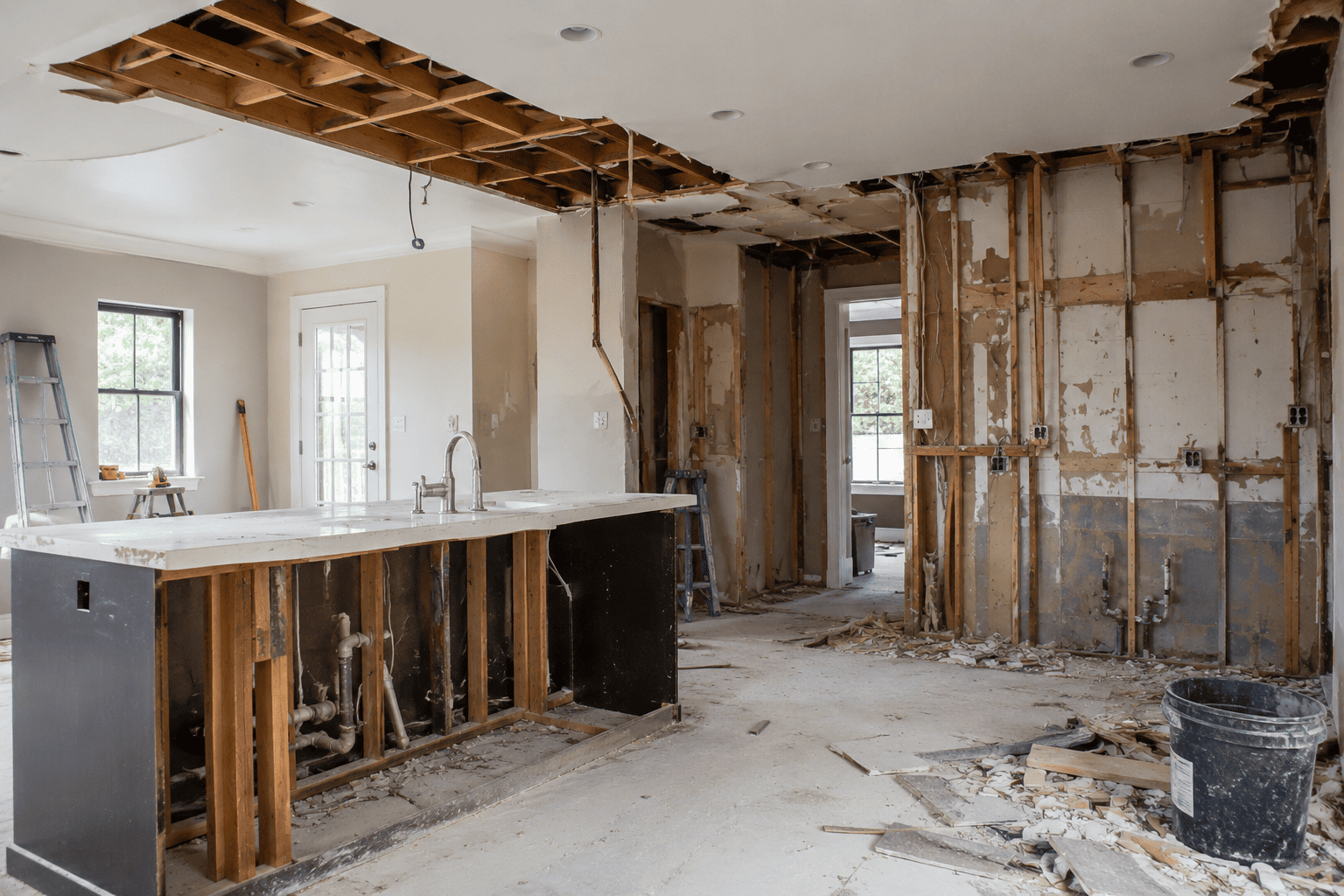
Permits, demolition, disposal fees, material delivery, temporary housing, and eating out during kitchen remodels are the expenses many homeowners forget to factor in at the outset. What starts as a $25,000 renovation can quietly creep toward $35,000 when these costs are left out of the original planning.
What to do instead: Allow 3 to 4 months for planning major renovations rather than rushing the process. Create detailed written specifications for all project elements before the first contractor conversation. Walk through every finish and fixture decision — flooring, tile, hardware, fixtures, paint — before work begins, not during it. Changes made on paper before demolition are free. Changes made once walls are open are expensive.
For budget planning specifically, the non-negotiable rule is a contingency fund of 15 to 20 percent of the total project cost. Renovation projects, by their nature, encounter surprises: old plumbing that’s corroded beyond what patching can fix, electrical panels that need upgrading to support new loads, structural discoveries that require engineering. The contingency doesn’t mean you’ll spend it — it means you’re protected when reality differs from the pre-demolition estimate.
Mistake 2: Hiring a contractor based on the lowest quote
The instinct to accept the lowest bid is understandable. Renovation costs are high, budgets are real, and a quote $5,000 below the competition seems like a windfall. In practice, it’s often the most expensive decision in the project.
The lowest quote typically reflects one of several realities: the contractor is inexperienced or underqualified for the scope, the bid is missing line items that will appear as change orders once work begins, or the contractor uses lower-grade materials than specified. None of these outcomes is cheaper in the long run.
Many homeowners fall into the trap of hiring inexperienced contractors or freelancers because they quote low. As the project progresses, they face unprofessional workmanship and substandard results.
The warning signs of a problem contractor are consistent: no contract or vague terms and conditions, no clear communication about what’s included and excluded, no warranty on labor or materials, inability to provide references from recent comparable projects, reluctance to pull required permits, and requests for large upfront cash payments.
What to do instead: Get a minimum of three detailed quotes for any project above $5,000. Compare them line by line — not just the total. Verify licenses and insurance independently (don’t take the contractor’s word for it). Check online reviews across multiple platforms, not just the ones the contractor provides. Call references and ask specific questions: was the project completed within the quoted price, on the quoted timeline, and was the site left clean and professional throughout?
The right question when evaluating quotes isn’t “who is cheapest?” It’s “which contractor is giving me the most accurate and complete picture of what this will cost and why?” The detailed, higher quote that accounts for all contingencies and has a clear payment schedule is almost always a better investment than the low quote that grows during execution.
Mistake 3: Skipping permits to save time or money
Skipping permits is the renovation mistake with the longest tail — it can cost you significantly more than the permit itself at every stage afterward, and the consequences often arrive at the worst possible moment.
Unpermitted work can delay a sale, reduce your home’s value, or even require costly corrections down the line. The consequences extend further: homeowners insurance may deny claims related to unpermitted work (a fire caused by unapproved electrical wiring, for example, may not be covered). FHA, VA, and other federally backed loans often require proof that all structures and systems are permitted and inspected, which can eliminate qualified buyers from your pool at resale.
When a buyer’s inspection or their lender’s appraisal identifies unpermitted work, you may be forced to legalize it (which requires opening walls, meeting current code, and re-inspecting), or remove it entirely — at the seller’s expense and on the buyer’s timeline. Permit costs range from $500 to $2,000 or more depending on project scope. The cost to retroactively permit or remove non-compliant work ranges from several thousand to tens of thousands of dollars.
Sellers who conceal known unpermitted work can be liable for misrepresentation or fraud — a legal exposure that creates risk far exceeding any permit cost avoided.
What to do instead: Always check with your local building department before starting any major renovation. Permits are typically required for structural changes, electrical work, plumbing changes, HVAC work, additions, and deck or patio construction. Minor cosmetic work — painting, flooring replacement, fixture swaps — generally doesn’t require permits. When in doubt, ask your local building department. The question costs nothing; the consequences of not asking can be enormous.
Mistake 4: Over-improving for the neighbourhood
This is the ROI killer that rarely gets discussed in renovation planning conversations, and it’s the reason why a homeowner can spend $150,000 on a renovation that adds $40,000 to their home’s value.
Every home exists within a market context. Buyers shopping in your neighbourhood have a price range in mind, and that range creates a ceiling on what any home in the area will sell for — regardless of its individual finishes. If you put a $100,000 kitchen in a neighbourhood where the average home sells for $300,000, the value of your home will not increase by $100,000. People who want to buy a house for $300,000 or less aren’t going to pay extra for a chef’s kitchen.
This principle applies to every upgrade category: a $50,000 master bathroom in a home surrounded by $250,000 comparable sales will not produce a $50,000 return. A primary suite addition that takes the home significantly above the neighbourhood’s average price point creates a home that’s difficult to value accurately and difficult to sell at a price that recovers the cost.
A useful guideline: a remodeling budget shouldn’t exceed 30 percent of what you’d expect the home to sell for. Beyond that threshold, the risk of investing more than the market will return increases significantly.
What to do instead: Before committing to any major renovation, understand comparable sales in your immediate area. Look at what homes with the features you’re adding have sold for in the past 6 to 12 months. Understand the ceiling — the highest price a home in your neighbourhood has achieved — and ensure your renovation cost plus current value doesn’t approach or exceed it. An experienced local real estate agent can give you this picture clearly in about 15 minutes, and that conversation is worth having before any significant renovation decision.
Mistake 5: Choosing materials based on upfront cost rather than total cost of ownership
This is the mistake that looks like savings at the point of purchase and reveals itself as an expense over the following years. Choosing the cheapest materials often leads to problems later — and the costs of those problems consistently exceed what the quality material would have cost upfront.
The pattern appears across every material category:
Flooring. Budget carpet in high-traffic areas typically lasts 3 to 5 years before showing significant wear. Mid-range carpet in the same areas lasts 8 to 12 years. The difference in upfront cost is $1 to $3 per square foot. The difference in replacement frequency over 15 years is the entire cost of the floor — installed — once or twice more.
Tiles. Cheap tiles crack more readily under point pressure and thermal cycling. Replacing individual tiles in a wet area — shower floor, kitchen backsplash — requires matching grout colour and tile lot, which is often impossible years after the original installation. The result is a full regrout or partial retile that costs more than the upgrade to mid-range tile would have cost at the start.
Cabinetry. Particleboard cabinet boxes with thin veneer fronts begin to show moisture damage and mechanical wear within 3 to 5 years in a kitchen environment. Plywood box construction with dovetail drawer joints and quality hinges lasts 15 to 25 years. The cost difference between these two specifications at the time of installation is real but modest relative to the service life difference.
Waterproofing and substrate. This is where cheap materials create not just inconvenience but structural damage. Inadequate waterproofing membrane in a shower or wet area allows moisture to reach the substrate behind the tile. Over months and years, this produces mould, rot, and structural decay that requires full demolition and reconstruction of the area — at costs many times what proper waterproofing would have cost. This is the material category where never cutting costs is the correct approach.
What to do instead: Evaluate materials on cost per year of service life rather than upfront cost. A flooring material that costs $4 per square foot and lasts 20 years costs $0.20 per year of use. A material that costs $2 per square foot and lasts 5 years costs $0.40 per year of use — twice as much for worse aesthetics. Apply this framework to every material decision, and spend less on finishes that don’t affect longevity while spending more on the materials whose performance determines how long the renovation holds up.
Mistake 6: DIYing work that requires professional licenses
The YouTube renovation video era has produced a generation of homeowners who are genuinely skilled at a surprising range of tasks — and some who have underestimated the specific categories where unlicensed DIY work creates real financial and safety risk.
The categories where DIY consistently creates expensive problems are: electrical panel work and circuit additions, plumbing changes involving supply or drain lines, gas connections and gas appliance installations, and structural changes including wall removal and beam installation.
The financial consequences of DIY errors in these categories are not small. Improperly installed wiring creates fire risk and insurance liability. Plumbing connections that leak inside walls cause water damage that manifests months later when mould and rot have spread through the structure. Gas connection errors create obvious catastrophic risk. Structural work done without engineering creates failure risk and can require complete reconstruction to correct.
The insurance dimension matters: homeowners insurance policies often exclude or limit coverage for damage caused by unlicensed work. If a DIY electrical installation causes a fire, your insurer may deny the claim on grounds that the work was improper — leaving you with both the fire damage and no insurance recovery.
Beyond the safety and insurance concerns, unpermitted DIY work in these categories creates the same resale and financing problems as any other unpermitted work. Buyers’ inspectors find it, lenders flag it, and you’re left managing the disclosure and remediation during what should be a straightforward sale.
What to do instead: DIY confidently in the categories where unlicensed work is legal and the risk of serious error is manageable: painting, tile installation (subject to proper substrate preparation), flooring installation, cabinet hardware replacement, light fixture swaps on existing circuits, and landscaping. Hire licensed professionals for electrical, plumbing, gas, and structural work — and verify licenses independently before hiring.
Mistake 7: Renovating before fixing deferred maintenance
This is a sequencing mistake that costs homeowners money in a specific way: cosmetic renovations installed on top of maintenance problems deteriorate faster, require earlier replacement, and sometimes mask problems that worsen beneath the surface.
The pattern: a homeowner installs a beautiful new bathroom vanity, tile, and fixtures on a floor that has a slow drain leak they haven’t addressed. Moisture from the leak gets into the subfloor beneath the new tile. Within two years, the grout is cracking, the tile has shifted, and the subfloor needs replacement — along with everything that was installed on top of it.
Or: new kitchen cabinets and countertops installed in a kitchen where the range hood vents into the wall cavity rather than outside. Condensation and cooking grease accumulate inside the wall, cause moisture and potential mould issues, and require opening the wall behind the new installation to correct.
Cosmetic upgrades layered on top of performance problems cost more in the end than fixing the underlying problem first and renovating second.
What to do instead: Before any cosmetic renovation, conduct or commission a thorough assessment of the existing condition of the systems and substrate beneath. Check plumbing for slow leaks at supply lines, drain connections, and under-slab if applicable. Check the electrical panel’s condition and capacity for the loads the renovation will add. Check the roof and weatherproofing for any penetration issues. Address deferred maintenance as the first phase of any renovation — then build the cosmetic work on top of a sound foundation.
Mistake 8: Ignoring the hidden costs until they arrive
Budget planning that accounts only for materials and labour is incomplete budget planning, and the gap between a materials-and-labour estimate and total project cost is where renovation budgets break down most reliably.
The hidden costs that most frequently blindside homeowners include:
Permit fees. Required for any structural, electrical, plumbing, or mechanical work. Range from $100 to $2,000+ depending on jurisdiction and project scope.
Demolition and disposal. Hauling away old cabinets, flooring, fixtures, and construction debris costs money — either in contractor labour or rented dumpster fees. A full kitchen demo generates significant volume.
Temporary accommodation. A kitchen gut renovation typically makes the kitchen unusable for 4 to 8 weeks. Eating out every meal for that period at even a modest level adds $500 to $1,500 to the project cost that never appears in the contractor quote.
Design and engineering fees. Structural changes require engineering drawings. Complex kitchen or bathroom layouts may benefit from professional design services. These fees are real costs that enable better execution — but they’re often budgeted separately or not at all.
Site preparation. Levelling subfloors, repairing damaged framing, moisture remediation, asbestos abatement in older homes — these are costs discovered during demolition that couldn’t be fully scoped before work began.
What to do instead: Build a complete project budget that includes the contractor quote, the contingency fund (15 to 20 percent), permit fees, disposal costs, temporary accommodation if applicable, and any design or engineering fees. The full picture prevents the psychological experience of a budget that seems intact in the quote and broken in the final cost.
Mistake 9: Chasing trends rather than timeless design
This is the mistake with the longest time horizon, and the one that produces the most design regret. Highly specific trend-driven finishes that feel current at the moment of installation feel dated within five to eight years — and in a renovation where the tile, cabinet colour, or fixture choice is expensive to change, you’re living with that datedness for a long time.
The 2015 renovation that went all-in on grey-painted everything, open shelving, and Edison bulb pendant lighting is now the renovation that needs updating. The 2010 renovation built around dark espresso cabinetry, travertine tile, and oil-rubbed bronze hardware is now the renovation that looks like 2010.
This doesn’t mean renovation choices should be anonymous or joyless. It means that the fixed, expensive-to-change elements — tile, cabinet construction, flooring, structural changes — are better served by timeless, broadly appealing choices, while trend expression is better reserved for the easily replaceable elements: paint colour, hardware, textiles, lighting fixtures.
What to do instead: Ask of any major finish decision: will this look current in ten years? A good test is to look at renovation photography from a decade ago. Anything that immediately reads as “that era” rather than “could be now” is the category of choice to avoid in high-cost, hard-to-change selections. Neutral floor tones, classic tile profiles, and cabinet styles that have existed for thirty years (rather than emerged in the last three) are the safer long-term investments.
Mistake 10: Treating the contractor relationship as adversarial rather than collaborative
The final mistake is relational but has direct financial consequences. Homeowners who approach their contractor relationship with suspicion, micromanagement, or constant scope changes create a dynamic where change orders proliferate, goodwill erodes, and the contractor’s best work doesn’t follow.
Conversely, homeowners who communicate clearly, make decisions promptly when asked, pay on schedule, and treat the contractor and their crew with professional respect consistently get better results — not necessarily because contractors play favourites, but because clear communication produces fewer errors, prompt decisions prevent costly delays, and mutual professionalism keeps the project momentum healthy.
The financial impact of a deteriorating contractor relationship is real: work that requires rework costs money and time, a contractor who has mentally checked out of a project doesn’t catch the small problems that save big costs later, and change orders that result from poor communication accumulate into a gap between the original quote and final invoice that could have been largely avoided.
What to do instead: Establish clear communication expectations at the project’s start. Get everything in writing — scope, materials, payment schedule, warranty. Make decisions when decisions are requested rather than deferring and creating schedule pressure. Pay on the agreed schedule when work meets quality standards. Walk the project regularly and communicate concerns promptly and professionally rather than letting them accumulate. A healthy contractor relationship is one of the most underrated factors in a renovation that finishes on time, on budget, and to the standard you actually wanted.
The pattern behind all of these mistakes
Reading through this list, a pattern emerges. Almost every costly renovation mistake is a form of false economy: the low contractor quote that grows through change orders, the skipped permit that creates resale complications, the cheap materials that need replacing twice before the expensive ones would have needed replacing once, the unpermitted DIY work that costs more to legalise than professional installation would have cost.
The homeowners who spend their renovation budgets most effectively are almost always the ones who planned thoroughly before starting, spent appropriately on the elements that determine long-term quality, hired professionals for the work that demands it, and treated the permit process as the protection it actually is rather than the obstacle it appears to be.
Renovation spending of $526 billion nationally doesn’t guarantee $526 billion in value created. The difference between a renovation that builds equity and one that drains it is almost always a collection of the decisions described above — most of which, with awareness, are entirely avoidable.