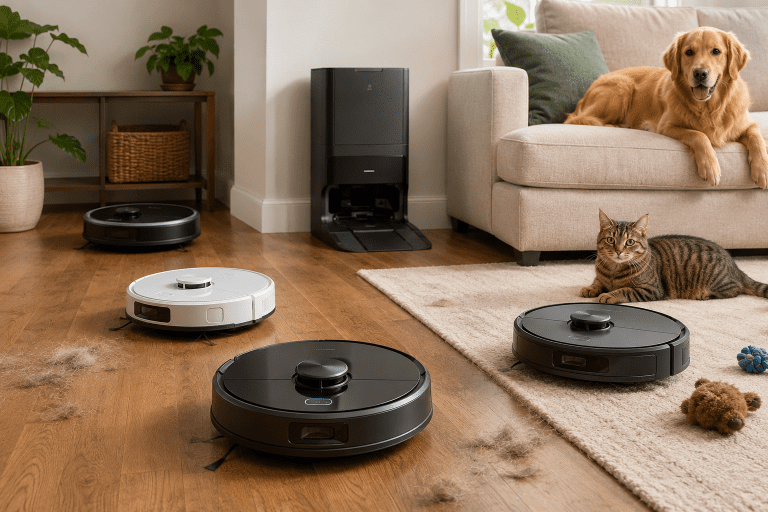
If you share your home with a dog or a cat, you already know the pattern. You vacuum on Saturday. By Tuesday, there are tumbleweeds of fur drifting along the baseboard. By Friday, you can’t tell you vacuumed at all.
Pet hair is genuinely one of the hardest cleaning challenges in a home, and it’s where a lot of robot vacuums fall apart — either because they lose suction on carpet, get tangled every other run, or miss the fine dander that makes sensitive noses run. Choosing the wrong robot vacuum as a pet owner doesn’t just waste money. It creates more frustration than the problem it was supposed to solve.
This guide cuts through the noise. We’ll explain exactly what makes a robot vacuum effective on pet hair, which features to prioritize, which to skip, and how to match the right machine to your specific situation — whether you have one cat on hardwood floors or three large dogs on thick carpet.
Why most robot vacuums struggle with pet hair
Standard robot vacuums are designed for general household debris: crumbs, dust, and light dirt. Pet hair presents three specific challenges that general-purpose machines handle poorly.
Tangling. Conventional bristle brushrolls are excellent at picking up pet hair — and also excellent at wrapping it into a dense, motor-straining tangle around the axle. This stops the brush from spinning, reduces pickup to nearly zero, and requires manual cutting to fix. On a robot you’re running daily, this becomes a chore in itself.
Filter clogging. Pet hair compresses into a layer over the filter that restricts airflow and kills suction. Fine dander, which passes straight through a standard filter, recirculates back into the air.
Volume management. A single large dog during shedding season can fill a standard robot vacuum dustbin in one room. Without adequate capacity or a self-emptying dock, you’re back to daily maintenance — defeating most of the purpose.
The good news: manufacturers have responded to this, and 2026 models are meaningfully better at pet hair than anything available even two years ago.
The four features pet owners must prioritize
Anti-tangle brushroll technology
This is the single most important feature for pet owners and the one most worth paying for.
Anti-tangle brushrolls use rubber fins or a combination of rubber and soft bristles arranged to guide hair toward the suction channel rather than wrap around the axle. In independent testing, the difference is significant — some premium anti-tangle designs maintain zero percent hair wrap even with 7-inch strands, while conventional bristle brushes on the same amount of hair end up nearly inoperable.
Look specifically for rubber extractors or dual-rubber rollers. Avoid models that only advertise “reduced tangling” from bristle brushes — the improvement is marginal. True anti-tangle performance comes from brushroll redesign.
HEPA filtration
Pet dander — the microscopic skin particles that cause allergic reactions, not the visible fur — is smaller than a standard filter can capture. A HEPA filter traps 99.97% of particles down to 0.3 microns, which includes pet dander, dust mites, and the fine particulates that trigger respiratory issues.
For households with allergy sufferers, HEPA filtration isn’t a luxury — it’s the difference between a robot vacuum that improves air quality and one that recirculates irritants through the room while it cleans.
If you have a self-emptying dock, a sealed, bagged system is preferable to bagless. When you empty a bagless dock, debris and fine particles are disturbed. A sealed bag keeps everything contained until disposal.
Self-emptying dock
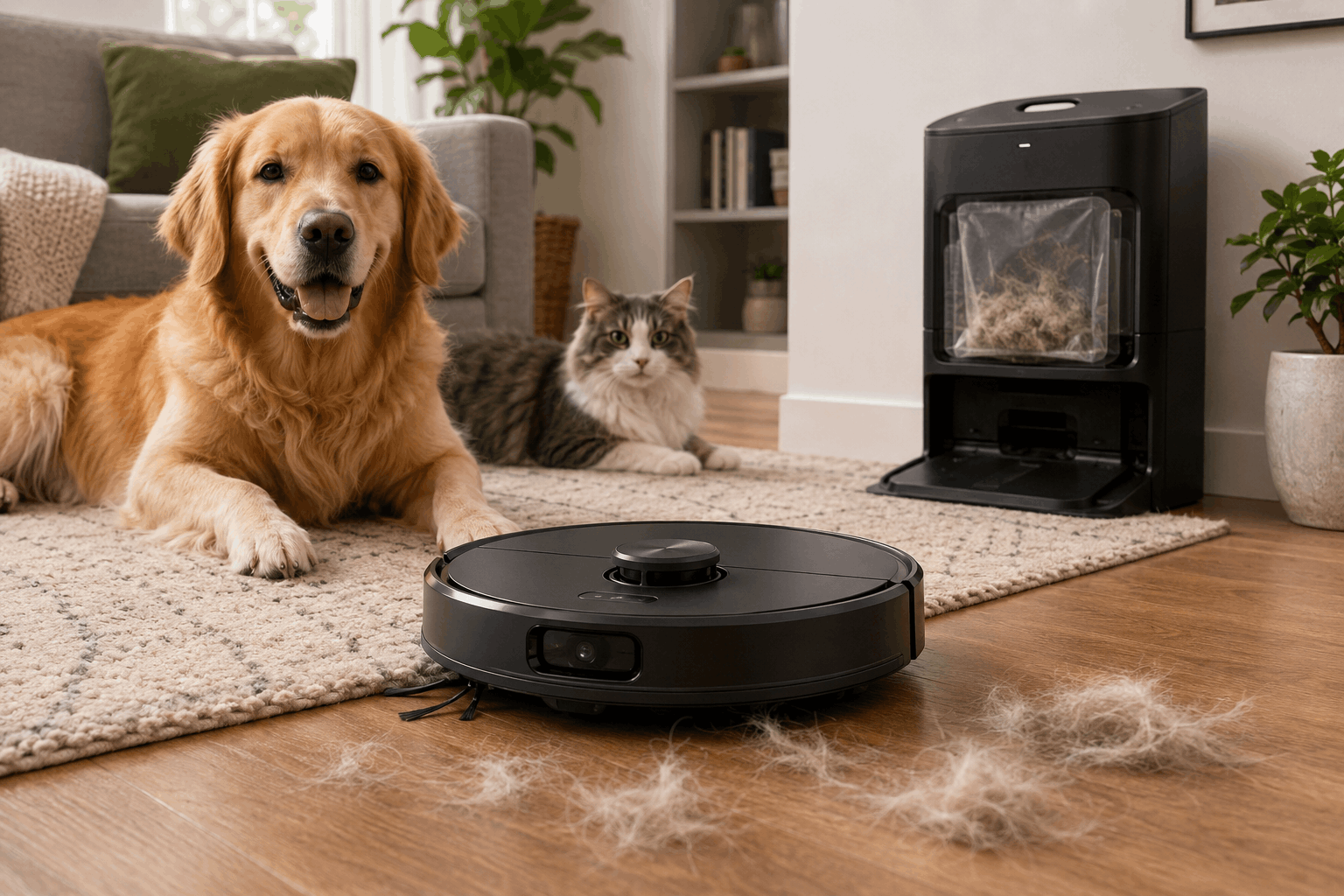
For pet owners specifically, a self-emptying dock moves from convenient to near-essential. Heavy shedders can fill a robot’s onboard dustbin in a single room. When the dustbin is full, the vacuum’s suction drops sharply — sometimes to the point of pushing debris around rather than picking it up.
A self-emptying dock removes this problem entirely. The robot deposits its debris after each run, and you deal with a larger bag every four to eight weeks rather than a small dustbin every day.
Suction power matched to your floor type
For hard floors, 2,000–4,000 Pa of suction is genuinely sufficient for pet hair. The rubber brushroll does most of the work; the suction removes what the brush loosens.
For carpet — particularly medium and thick-pile — pet hair embeds in the fibers and needs more force to extract. 6,000 Pa or above is the practical minimum for reliable carpet pet hair pickup. Above 10,000 Pa, you’re in premium territory that handles even the most demanding carpet conditions and heavy shedding breeds.
What to look for by pet type
Short-haired cats and small dogs (light shedders) A mid-range robot with a rubber brushroll and self-emptying dock handles this well. 4,000–6,000 Pa suction on a mix of hard floor and low-pile carpet. HEPA filter recommended.
Long-haired cats or medium dogs (moderate shedders) Anti-tangle brushroll becomes essential here. Look for specifically designed rubber dual-rollers, not just low-bristle designs. 6,000+ Pa if you have any carpet. Self-emptying dock with bagged system if anyone in the household has allergies.
Large dogs or multiple pets (heavy shedders) You need the full package: premium anti-tangle brushroll, 8,000+ Pa suction, HEPA filtration, self-emptying bagged dock, and a robot that runs daily. Budget $600–$900 and treat it as a worthwhile ongoing investment.
Pets with accidents If your pet occasionally has accidents on the floor, obstacle avoidance with AI camera-based recognition (specifically trained to identify pet waste) is worth the premium. Several models from Roborock and iRobot offer verified pet waste avoidance — the robot detects and routes around messes rather than spreading them. This is one of the few scenarios where camera-based AI navigation is directly worth its cost.
The allergy question
Many pet owners deal not just with visible hair but with allergic reactions — runny eyes, sneezing, itchy skin — triggered by dander and fine particulates that settle on floors and get disturbed when you walk through. A robot vacuum running daily actually reduces the total dander load in a home significantly, provided it’s filtering it rather than recirculating it.
Studies have found up to an 89% reduction in airborne pet dander levels in homes where robot vacuums with HEPA filtration run daily. That’s a meaningful health benefit, not just a cleaning convenience.
To achieve this:
- HEPA filter is required, not optional
- Sealed dustbin system (especially important at the emptying stage)
- Bagged self-emptying dock over bagless
- Clean or replace the filter on schedule (every 2–3 months minimum; more frequently with heavy shedders)
Maintenance realities for pet owners
Even the best anti-tangle brushroll needs attention. Check the brushroll and axle ends weekly — not just the visible surface of the brush, but the ends where hair accumulates in a ring. A pair of scissors handles anything that wraps.
With pets, clean the filter more frequently than the standard schedule. Tap it out over a trash can after every few runs, and replace it every 2–3 months rather than every 6 months.
Side brushes — the small spinning brushes on the robot’s underside that pull debris from edges — catch pet hair too. Check them weekly and replace them every 3–4 months with heavy pet use.
Sensors and the robot’s underside collect pet hair and dust. A quick wipe with a dry cloth weekly keeps navigation accurate and prevents the robot from getting confused about room boundaries.
How often should pet owners run their robot vacuum?
Daily is the honest answer for moderate to heavy shedders. Pet hair accumulates continuously, and a daily run keeps the volume manageable — both for your floors and for the robot’s dustbin. Running daily is also far easier on the brush and motor than infrequent deep sessions, because you’re never asking the machine to process a week’s worth of accumulated hair at once.
For light shedders, every other day is sufficient. For single-pet households on mostly hard floors, three times a week may be adequate.
Schedule the robot to run when you’re out. Beyond the noise consideration, running while you’re away means the floor has time to settle before you walk on it, and the robot isn’t navigating around you.
The one thing most pet-focused reviews miss
Pet hair vacuuming gets most of the attention, but the cleaning dock matters enormously for pet households and is often barely mentioned.
A dock that washes mop pads with hot water (67°C or above) sanitizes them between runs, which matters when your mop is picking up pet-related residue from your floors daily. Some 2026 premium models heat wash water to 75°C, which effectively kills bacteria and odors rather than just rinsing debris off. If you have a vacuum-mop combo and pets, look for hot water mop washing in the dock specs.
Bottom line for pet owners
The best robot vacuum for pet hair is one that you can realistically run every day without it becoming a maintenance burden. That means anti-tangle rubber brushroll, a self-emptying dock, and HEPA filtration as the non-negotiable baseline. The suction level and premium features layer on top depending on your floor types and how heavy your pet’s shedding is.
Budget $500–$800 for a pet household and you’ll find excellent options that handle even substantial daily shedding without weekly intervention. Anything below $400 in a heavy-shedding household typically creates more work than it saves.