Why Do My Legs Feel Restless at 3 PM? How to Fix Under-Desk Circulation
That mid-afternoon heavy, twitchy feeling in your legs isn’t random fatigue—it’s a direct physiological signal that blood is pooling in your lower extremities from hours of static sitting.
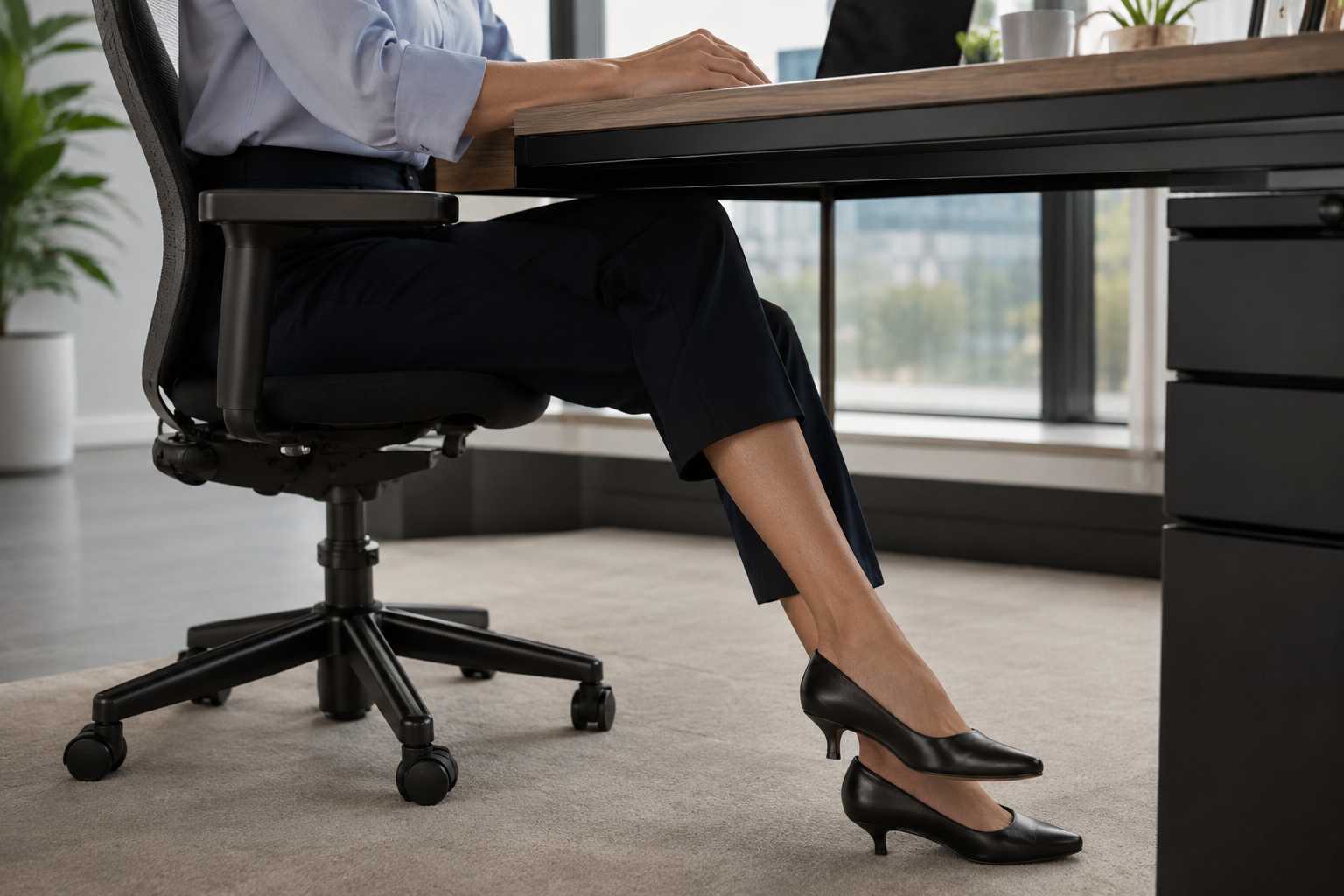
You’ve been at your desk since morning, meetings have come and gone, and somewhere around 3 PM your legs start to feel… off. Heavy. Restless. Maybe you catch yourself bouncing your foot or shifting in your seat every few minutes without quite knowing why.
That 3 PM restlessness is not random, and it’s not just afternoon fatigue. It’s your body signaling a real circulatory problem: blood pooling in your lower legs from hours of sitting still.
Why Your Legs Feel Restless by Mid-Afternoon
When you sit for long stretches, gravity pulls blood downward into your lower legs and feet. Under normal circumstances, your calf muscles act as a kind of second heart, contracting rhythmically as you walk to squeeze blood back up through your veins toward the heart. Researchers describe this as the “calf muscle pump,” and it’s responsible for roughly 90% of venous return from the lower extremities during movement.
The problem? When you’re seated and stationary, that pump basically shuts off.
The Physiology of Sitting: Prolonged sitting increases hydrostatic pressure in the leg vasculature, causing blood to pool in the venous circulation and increasing calf circumference. After just three hours of static sitting, heart rate, diastolic blood pressure, and leg swelling increase significantly.
That pooling is what makes your legs feel heavy, tight, or inexplicably restless. The urge to fidget or bounce your leg is, in a way, your nervous system trying to restore circulation.
Why It Peaks at 3 PM
Most desk workers arrive at a slow accumulation of sitting time across the day. By mid-afternoon, the effects compound. You may have already logged five or six continuous hours in your chair. Blood has had more time to pool, and sustained muscle inactivity makes vascular changes noticeably pronounced.
5+ hours of seated gravity causes steady fluid accumulation in lower leg veins and tissues.
Extended inactivity of the calf pump forces one-way venous valves to sit idle for hours.
The Canadian Centre for Occupational Health and Safety recommends active breaks of around 5 minutes for every 40 to 50 minutes of sitting. Because most people don’t do this, restlessness catches up right around 3 PM.
The Calf Muscle Pump: Why Small Movements Matter
Understanding the calf muscle pump changes how you think about desk movement. The actual mechanics of venous return depend on rhythmic compression of the deep veins in your lower leg.
When your calf contracts, it compresses the deep veins, forcing blood upward while one-way valves prevent backflow. Upon relaxation, blood refills from capillaries for the next squeeze. Studies suggest this mechanism can achieve ejection fractions of around 65% per contraction cycle during walking.
Sitting still eliminates that cycle almost entirely. The muscle pump stops, the valves sit idle, and blood stagnates in the lower leg. Any rhythmic activation of the calf muscles restores some of that pumping action.
How Passive Vibration and Rocking Footrests Can Help
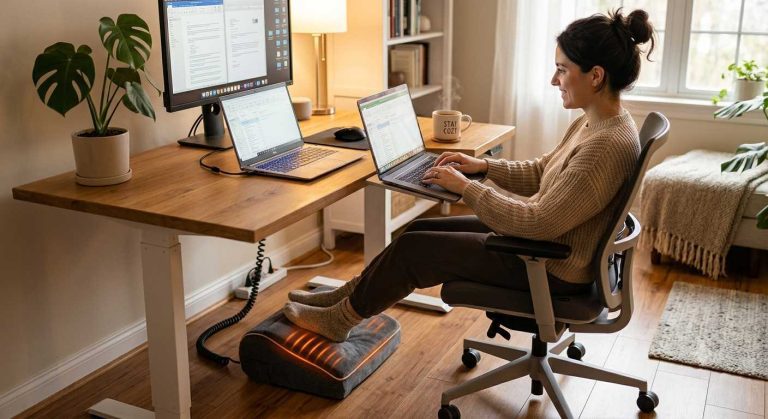
Walking away from your desk every 40 minutes isn’t always practical due to meetings or deep focus work. Under-desk tools like vibrating or rocking footrests offer a genuine solution for keeping the calf muscle pump active while remaining seated.
| Tool / Mechanism | How It Works | Circulatory Impact |
|---|---|---|
| Vibrating Footrest | Transmits oscillating motion into lower leg musculature. | Mechanically extrudes venous blood and increases calf tissue oxygen saturation within 30 seconds. |
| Rocking Footrest | Encourages gentle back-and-forth ankle pivoting. | Requires active, low-effort calf contractions that trigger the skeletal muscle pump naturally. |
A few practical setup tips for optimal leg circulation:
- Placement: Keep feet flat on the surface with knees at roughly a 90-degree angle.
- Intensity: Start on lower settings with vibrating platforms to assess leg comfort.
- Combination: Pair passive footrest tools with active micro-movements like ankle rolls.
Other Things Worth Doing During the Workday
Keep heels down and lift toes, then reverse. Doing 20 reps per hour directly activates the calf pump in 30 seconds.
Raise heels off the floor while keeping toes grounded to flex the gastrocnemius and soleus muscles.
Research confirms even a brief 2-minute stroll restores lower leg vascular function impaired by sitting.
Staying hydrated reduces blood viscosity, supporting smoother venous return and reducing heavy-leg sensations.
Key Takeaways
- Leg restlessness at 3 PM is caused by gravity-induced blood pooling in the lower legs due to an inactive calf muscle pump.
- The calf muscle pump accounts for ~90% of lower extremity venous return; static sitting shuts it down.
- Rhythmic lower leg activation via vibrating or rocking footrests extrudes stagnant blood and increases calf muscle oxygenation.
- Simple hourly micro-habits—like 20 ankle pumps or a quick 2-minute walk—restore vascular dilation and reduce leg heaviness.
- Proper foot placement at a 90° knee angle combined with active or passive footrest movement solves afternoon leg fatigue at the root.
Wrapping Up
That restless, heavy feeling in your legs at 3 PM is your body pushing back against hours of sitting still. Blood pools in the lower legs when the calf muscle pump is inactive, and by mid-afternoon, the effects are hard to ignore.
The good news is that the solution doesn’t require a standing desk or a gym break. Keeping the calf muscles stimulated, through small voluntary movements, rocking footrests, or vibrating platforms, can make a meaningful difference in how your legs feel through the back half of the workday.
References and Resources: Pomeroy & Stone, “Cardiovascular Effects From Venous Blood Pooling in Lower Limbs” (PubMed); Thosar et al., “Impact of Prolonged Sitting on Limb Micro- and Macrovascular Function” (PMC); “Prolonged Sitting Induces Elevated Blood Pressure” (PMC); “In the Unloaded Lower Leg, Vibration Extrudes Venous Blood” (PMC); “The Calf Muscle Pump Revisited” (Journal of Vascular Surgery); CCOHS “Working in a Sitting Position”; “The Skeletal Muscle Pump” (LearnMuscles.com 2026).