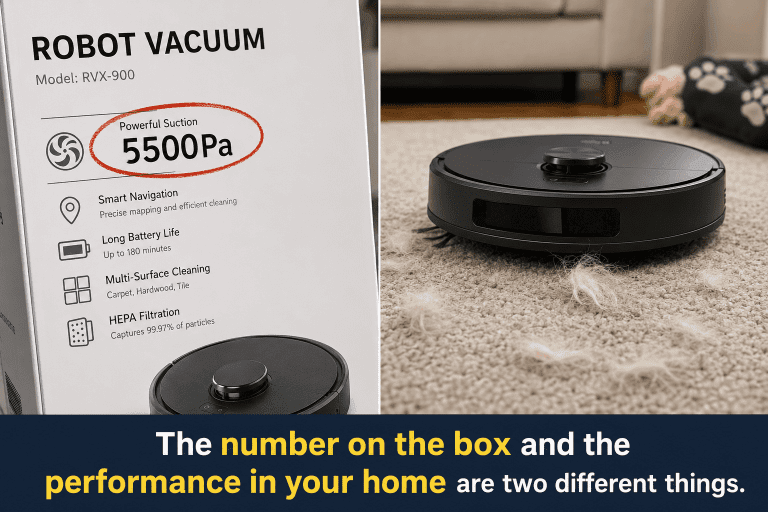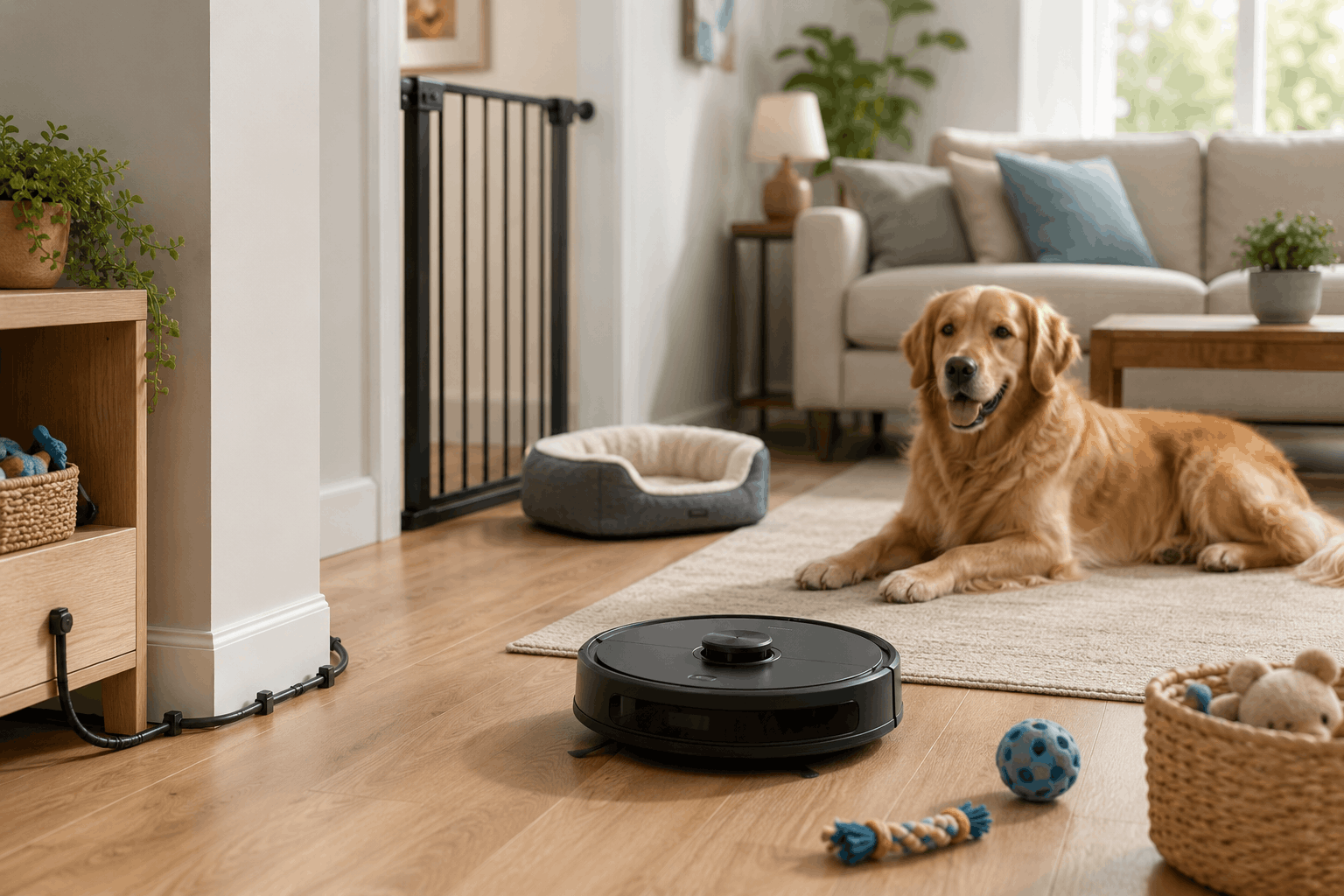
A robot vacuum and a pet-filled home should be a perfect match. The robot runs daily, stays ahead of the relentless shedding, and saves you from the exhausting battle of vacuuming up pet hair multiple times a week. In practice, the combination works brilliantly — when the home is set up for it. Without a bit of preparation, a pet household is also an obstacle course of cables, toys, food bowls, rogue socks, and the occasional accident that turns a robot vacuum run from a hands-off win into a frustrating mess.
The good news is that pet-proofing a home for a robot vacuum takes less time than most owners expect, and most of it only needs to be done once. After an initial setup session, you’re left with a home where the robot runs reliably, the floors stay genuinely clean, and you’re not coming home to a machine stranded in the corner with a chew toy wrapped around its brushroll.
This guide covers every dimension of the problem: cables and cords, pet toys and accessories, food and water stations, rugs and floor hazards, pet accidents and waste, and the ongoing habits that make the whole system work.
Why pet homes specifically challenge robot vacuums
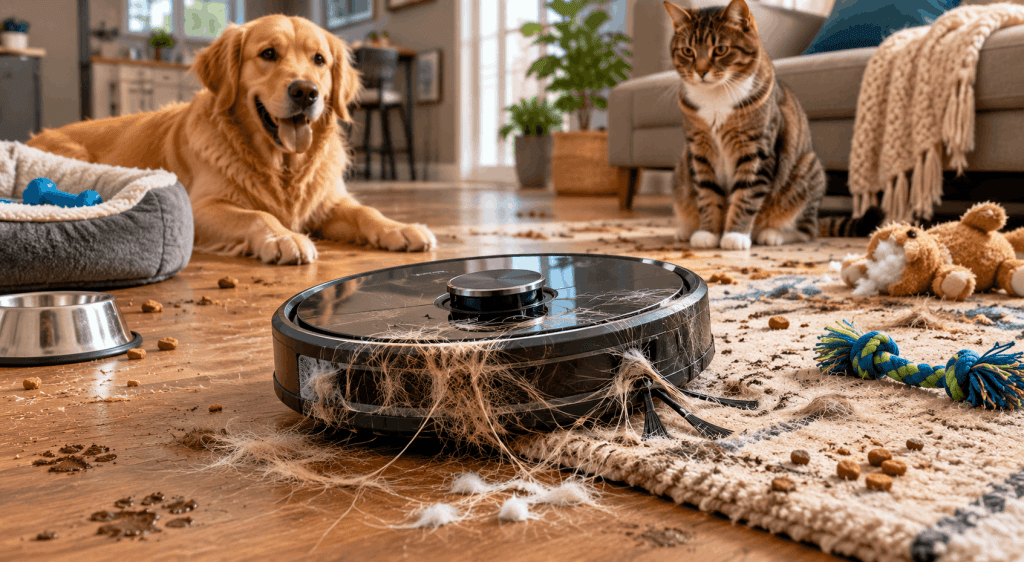
A robot vacuum navigating a pet-free home encounters furniture, cables, and occasional clutter. A robot vacuum navigating a home with one or more animals encounters all of that plus a dynamic, unpredictable environment where obstacles change daily and some of those obstacles are genuinely catastrophic if encountered.
Pet owners often report vacuums getting caught on leashes, litter boxes, or food bowls. Even seemingly harmless items like magazines or throw blankets left on the floor can trigger entrapment.
The specific challenges in pet households break down into five categories:
Physical obstacles — toys, bedding, leashes, food bowls, and anything else a pet leaves on the floor that changes position between runs.
Cable hazards — charging cables for phones and laptops become especially problematic when pets pull them from outlets, chew on them, or drag them across the room.
Soft floor obstacles — rugs, pet beds, and bathroom mats that can bunch up under the robot, flip at the edges, or trap the machine.
Sensor contamination — pets rub against the robot, lick its sensors, and leave nose prints on cameras and laser windows. Dogs sniff the robot. Cats rub against it. This leaves nose prints and oil on the camera lens or laser window, directly affecting navigation accuracy.
Pet accidents — the scenario every robot vacuum owner with a pet dreads. A robot that encounters pet waste and isn’t equipped to detect and avoid it spreads the mess systematically across every floor it visits.
Understanding these categories makes the solutions clear and logical rather than a random list of tips.
Step one: tackle the cable situation once and properly
Cables are the most common cause of robot vacuums getting stuck or damaged in any household, and in pet homes the problem is compounded by the fact that pets actively interact with cables — chewing on them, dragging them, and pulling them from outlets. Chargers, shoes, pet toys, and clothes are all traps for robot vacuums.
The approach to cables that works is not “tidy them up before each run.” That’s a daily overhead that will eventually stop happening. The approach that works is a one-time cable management investment that makes cables permanently inaccessible to both your robot vacuum and your pet.
Route cables along walls and secure them. Adhesive cable clips — available at any hardware store for a few dollars — secure cables to skirting boards and wall edges, keeping them flat against surfaces where robot wheels can’t catch them. This takes 20 to 30 minutes for a typical home and eliminates the cable problem essentially permanently.
Use cable covers for floor crossings. Where cables must cross open floor space — in front of an entertainment unit, under a desk — plastic floor cable covers create a ramp that robots drive over without catching. They also protect cables from being chewed, which is a dual benefit in pet homes.
Use under-desk cable trays. For home office setups with multiple cables, a cable management tray mounted under the desk keeps all cables off the floor entirely. The robot passes under the desk and finds nothing to catch.
Set no-go zones around the worst areas. For areas where cable management isn’t practical — behind an entertainment unit, around a charging station with multiple cables — set a virtual no-go zone in your robot’s app. The robot simply never goes there. Bundle TV cables behind the stand, route phone chargers up a desk leg, or use under-desk trays to keep computer cords off the floor.
Step two: create a system for pet toys
Pet toys are among the most common robot vacuum stoppers in pet households. They’re low to the ground, irregularly shaped, and tend to be exactly the right size to catch in brushrolls or jam under the robot’s chassis. Even premium robot vacuums with sophisticated obstacle avoidance can struggle with soft toys, rope toys, or small balls that the AI hasn’t been specifically trained to identify.
The practical solution is not to rely entirely on the robot to avoid toys — it’s to build a habit that keeps toys off the floor before cleaning runs.
Designate a toy basket or bin in each room. A low basket that a dog or cat can access for play but that becomes the default toy storage location creates a simple end-of-day routine: toys go in the basket before bed, robot runs overnight or in the morning. The basket is also something you can set a no-go zone around, so the robot doesn’t try to vacuum around or over it.
The 30-second toy sweep. Before the scheduled clean, do a 30-second “toy sweep.” Throw the big chew toys into a basket. This gives the robot a clear path to clean the areas where dirt actually hides, rather than dancing around obstacles. This habit takes genuinely 30 seconds and eliminates the majority of pet-toy-related stoppages.
Set the robot’s schedule after peak play time. If your pet plays most actively in the morning, schedule the robot for early afternoon when toys are more likely to have settled. If play happens in the evenings, an overnight schedule works better. Timing the robot’s runs around your pet’s activity patterns reduces encounters with freshly displaced toys.
Consider which toys live on the floor permanently. Some pets have a favourite toy that essentially lives on the floor all day. Map these locations in your robot’s app as no-go zones, or accept that the robot will route around them as a consistent obstacle after a few mapping runs.
Step three: manage food and water stations
Pet food and water bowls present a specific set of robot vacuum challenges. The bowl itself is an obstacle. The area immediately around a food bowl typically has scattered kibble and food debris. The area around a water bowl is often damp from splashing. Each of these creates a different problem for a robot vacuum.
Set a no-go zone around feeding stations. The easiest and most reliable solution is to draw a virtual no-go boundary in the robot’s app around the feeding area — typically a zone of about 1 to 1.5 meters around food and water bowls. The robot skips this area entirely, you vacuum or sweep the feeding area manually during regular clean-up, and you never risk the robot tipping a water bowl or scattering kibble further across the floor.
Use a feeding mat. A silicone or waterproof feeding mat under food and water bowls contains the mess in a defined, wipeable area. It’s also easier to lift and wipe than cleaning individual kibble from a wide floor area. The mat creates a clear boundary that you can set the no-go zone to match.
Elevate food and water where possible. Raised feeding stations designed for larger dogs bring bowls above the robot’s reach, eliminating the tipping risk entirely. For smaller pets, a bowl with a weighted base is less likely to be displaced if the robot approaches it.
Keep water away from robot sensors. A splashing water bowl near the robot’s dock creates a moisture risk for the machine’s charging contacts and underside sensors. Position the dock in a location where water bowls aren’t in the immediate vicinity.
Step four: address rugs, pet beds, and soft floor obstacles
Pet households tend to have more soft floor obstacles than pet-free ones: pet beds scattered across rooms, rubber-backed pet mats at doors and feeding areas, and sometimes multiple area rugs in living spaces. Each of these presents specific challenges.
Pet beds. Robot vacuums cannot clean on top of elevated pet beds and frequently get stuck trying to mount them. The best approach depends on the bed: if it’s lightweight, move it to a corner and set a no-go zone. If it’s a fixed, foam mat-style bed, set a no-go zone around it permanently. Don’t rely on the robot to navigate around a pet bed reliably — the soft, irregular edges confuse obstacle sensors on most models.
Pet mats and rubber-backed floor mats. Fold up or remove lightweight rugs that might bunch up under the robot. Rubber-backed mats at entryways are particularly problematic — the rubber grip that holds them to the floor also resists the robot’s ability to slide past edge sensors, and the robot can flip the mat or get stranded on top of it. Either remove these before cleaning runs or set no-go zones to exclude them.
Area rugs with fringe or tassels. Products with cords, strings or tassels, notably fringe on area rugs, must be taped down or blocked off since they will wrap around the brushes and stop the machine. In pet homes, this is worse than in others because pets often pull at fringe, leaving tassels spread further across the floor. Use rug tape to secure fringe flat along the rug edges, or set a boundary that keeps the robot off fringed rugs entirely.
Dining chairs. Furniture legs, especially dining chairs and bar stools, pose perplexing obstacle courses. The vacuum gets underneath and then it can’t seem to find an exit. Push in dining chairs all the way before cleaning cycle. In pet homes where chairs are constantly moved during feeding or play, this is an especially common cause of stoppages. Push dining chairs fully under the table before any cleaning run.
Step five: the pet waste problem — and how to handle it honestly
This is the scenario that generates the most anxiety for robot vacuum owners with pets, and rightfully so. A robot that encounters pet waste and doesn’t detect it becomes a vehicle for spreading that waste across every room it subsequently visits. It is as bad as it sounds.
The technology landscape in 2026 has improved considerably. Many robot vacuums today are equipped with smart sensors, obstacle avoidance, virtual boundaries and advanced cameras to help the vacuum avoid dog poop and pet waste. With these features the vacuum can detect and avoid surprise messes which reduces the chances of an incident. But there’s no 100% assurance that they will avoid pet waste in all situations.
The most vigilant robot vacuums to come out of CES 2026 can recognize between 200 and 300 different objects. Several brands — including Roborock, iRobot, and Ecovacs — specifically train their AI models on pet waste imagery, and their detection rates have improved substantially. But “improved” is not the same as “guaranteed.”
The practical framework for pet waste management:
If your pet has occasional indoor accidents: A robot vacuum with verified pet waste avoidance capability is worth the premium. Roborock’s Saros series, iRobot’s Roomba j-series, and Ecovacs’ recent DEEBOT X-series all include specifically trained waste detection. This is one scenario where the AI camera upgrade directly earns its cost. Still, on days you suspect your pet may have had an accident, check the floor before the robot’s scheduled run.
If your pet has regular or frequent accidents: Don’t run the robot unsupervised until the issue is addressed, regardless of what waste-detection capability your robot has. Set the robot to run only while you’re home and able to monitor, or adjust the schedule to times you can do a quick visual check beforehand.
The universal rule: Prepare the cleaning area before you start so that it doesn’t get messy. Walk around the house to see if your dog has pooped somewhere and clean it up before you switch your robot vacuum on. No waste-detection system makes a pre-run visual check unnecessary — it just reduces the consequences of missing something.
Set restricted zones around areas where accidents most frequently occur. If your pet tends to have accidents in a specific corner, near a specific piece of furniture, or in a room they sleep in, set a no-go zone around that area to exclude the robot from the highest-risk location.
Step six: sensor maintenance for pet homes
In pet households, the robot’s sensors and cameras need more frequent cleaning than the standard schedule suggests. Pets interact with the robot physically — sniffing, rubbing, occasionally licking — and this leaves residue that directly affects performance.
A robot vacuum sees the world through infrared and optical sensors. Dogs sniff the robot. Cats rub against it. This leaves nose prints and oil on the camera lens or laser window. A sensor covered in nose oil produces blurred or inaccurate obstacle detection — the robot navigates less accurately and the waste-avoidance capability it’s supposed to have becomes unreliable.
Weekly sensor wipe: Use a dry microfibre cloth to wipe all accessible sensors every week — cliff sensors on the underside, wall-following sensors on the sides, the LiDAR window on top (where present), and any obstacle-detection cameras on the front face. For cameras specifically, a barely-dampened cloth removes oils more effectively than dry wiping.
Keep the robot’s home base away from pet activity areas. The dock is where the robot lives when it’s not cleaning, and it becomes a place pets investigate. Positioning the dock in a lower-traffic area reduces how often pets rub against it and how often debris and pet hair accumulates on the dock’s charging contacts.
Step seven: brushroll and dustbin frequency for pet homes
Pet homes generate significantly more debris per run than pet-free homes, which means the standard maintenance schedule needs adjustment.
Check the brushroll every run during high-shedding periods. Anti-tangle rubber brushrolls handle pet hair far better than bristle brushes, but they still accumulate hair at the axle ends during heavy shedding seasons. Once a week, flip the robot over. Check the bearings at the ends of the brush roll. Hair often migrates to the sides and wraps around the metal axles. Removing this friction prevents the motor from burning out and keeps the battery life healthy.
Empty the dustbin after every run if you don’t have a self-emptying dock. A dustbin that’s 50 percent full before a run starts produces noticeably reduced suction before it’s done — and with pets, bins fill faster than you’d expect.
For self-emptying docks: replace the bag more frequently than the standard interval. Where a standard household might go 45 to 60 days between bag changes, a heavy-shedding pet household may need replacement every 20 to 30 days.
Clean the filter more often. Pet dander compacts on filters faster than household dust. Tap out the filter every few runs rather than weekly, and replace it every 2 months rather than every 3 to 4 months in a pet household.
Step eight: setting up the app for a pet household
The robot vacuum app is where several of the physical preparations above get reinforced with digital boundaries. Spending 20 to 30 minutes on app setup after the first complete floor mapping is one of the highest-return investments of time in a pet household.
No-go zones to set permanently:
- Around feeding stations and water bowls
- Around pet beds
- Around problematic rugs with fringe or rubber backing
- Around the area behind or under entertainment units with cable concentrations
- Around litter boxes (important: many robot vacuum owners miss this — a robot that runs through cat litter scatters it)
- Around any corner or room where accidents have previously occurred
Scheduled run timing: Set the robot to run at a time that works with your pet’s daily routine. Most owners find that scheduling runs while they’re away from home (at work or on errands) works best — the pet is not disturbed by the robot’s movement, and you return to clean floors. Avoid scheduling during times when pets are actively playing or have recently eaten.
Run frequency for pet homes: Daily is the right baseline for moderate to heavy shedders. By running the robot every single day, you ensure the floor never gets dirty enough to be a problem. Daily runs also mean the robot is never processing a large accumulated debris load, which is easier on the brushroll and motor over time.
The pet-proofing checklist
Work through this once when you first set up your robot vacuum in a pet home, then revisit it monthly to make sure nothing has drifted.
Physical preparation (do once, maintain occasionally):
- All cables routed along walls with clips or covered by floor cable covers
- Feeding station no-go zone identified and measured
- Feeding mat in place under bowls
- Pet beds mapped — no-go zones or relocation plan confirmed
- Rubber-backed mats identified and either removed for runs or excluded via no-go zones
- Rug fringe taped flat or rugs excluded via no-go zones
- Dining chairs pushed in before scheduled runs
App setup (do once during initial mapping):
- No-go zones set: feeding area, pet beds, litter box area, cable concentrations
- Cleaning schedule set for optimal timing relative to pet routine
- Run frequency confirmed at daily (or at minimum every other day)
Ongoing habits (daily or weekly):
- 30-second toy sweep before scheduled run
- Quick visual check for accidents before run (especially relevant if pet has health issues)
- Weekly sensor wipe
- Brushroll axle check weekly during shedding season
- Dustbin emptied after every run (or dock bag checked monthly)
- Filter tapped out every few runs, replaced every 2 months
The result: a pet home that actually stays clean
The households where robot vacuums work best with pets are ones where a small investment of setup time has been made upfront. The physical cable management, the app no-go zones, the toy basket habit — none of these are complicated, and none require significant ongoing effort once established.
What they produce is a home where the robot runs reliably, without stranding itself in the corner or spreading something it shouldn’t have encountered, where the floors stay genuinely clean on a daily basis despite the shedding and mess that come with animals, and where your own maintenance involvement is limited to the quick weekly checks that keep the machine running well.
The robot vacuum earns its place in a pet home more than almost anywhere else. With the right setup around it, it runs without you thinking about it — and your floors stay clean without you working for it.