How an Under-Desk Footrest Can Reduce Your Lower Back Pain
If your lower back starts aching by mid-afternoon, your feet might be to blame. Discover the biomechanical chain reaction between foot grounding, pelvic alignment, and spinal health.
If your lower back starts aching by mid-afternoon, you’ve probably already blamed your chair. Maybe you’ve adjusted the lumbar knob, sat up straighter for a few minutes, then gradually slouched back into the same position an hour later. It’s a familiar cycle. But here’s something most people don’t think to check: where are your feet right now?
An under-desk footrest is one of the more overlooked pieces of desk ergonomics. It sounds minor. It isn’t. The way your feet make contact with the ground (or don’t) has a direct effect on how your pelvis sits, which in turn affects your entire lower spine. This article walks through the biomechanics behind that chain reaction and explains why a simple footrest can do more for your lower back than many people expect.
Why Your Feet Are the Foundation of Your Seated Posture
Sitting posture is built from the ground up. When your feet rest flat with even weight across both soles, your lower body is grounded and stable. When they’re dangling, angled awkwardly, or only partially touching the floor, something else has to compensate and that’s usually your pelvis and lower back muscles.
The pelvis is the hinge between your legs and your spine. When it tilts backward (what ergonomists call a posterior pelvic tilt), the natural inward curve of your lower back (lumbar lordosis) flattens out. Research published in PMC confirms that the degree of pelvic backward tilt increases as sitting posture deteriorates, and that lumbar lordosis decreases along with it. A flattened lumbar curve puts more pressure on the spinal discs and forces the muscles around your lower spine to work continuously just to hold you upright.
For many desk workers, this isn’t a posture problem so much as a geometry problem. If your chair is set to the right height for your desk but your legs are too short to reach the floor comfortably, your pelvis has nowhere to anchor itself. A footrest solves this by bringing the floor up to meet you.
The Pelvic Tilt Problem (And How Elevation Fixes It)
Here’s what actually happens when you place your feet on a footrest. By slightly elevating your feet, you shift the angle at your hips. This gentle change in hip flexion encourages the pelvis to rotate forward (anterior rotation) into a more neutral position. That neutral position is where your lumbar curve can be maintained naturally, without you actively having to hold it.
Ergonomic Insight: When feet lack proper support, the pelvis tilts posteriorly, flattening the natural lower back curve and increasing pressure on spinal discs. A correctly positioned footrest maintains a neutral pelvis, supporting natural lumbar lordosis without continuous muscle strain.
The difference between a well-supported pelvis and a poorly-supported one isn’t just about comfort in the moment. Over a full work day, chronically engaged lower back muscles build up fatigue and stiffness. Research in the MDPI Biomechanics journal found that prolonged slumped sitting significantly increases lumbar muscle stiffness. That stiffness is often what you feel at the end of the day as a dull, persistent ache.
Why a Footrest Makes Your Lumbar Support Actually Work
Most ergonomic chairs come with some form of lumbar support, whether that’s a built-in curve in the backrest, an adjustable lumbar pad, or a separate cushion. These features are designed to maintain your lower back’s natural inward curve while you sit. But there’s a catch: lumbar support only works if you’re actually sitting back in the chair.
Many people perch toward the front edge of their seat, which means the lumbar support behind them is doing nothing. This tends to happen when feet aren’t properly grounded. Without foot support, people unconsciously shift forward to stabilise themselves, pulling away from the backrest.
Perched Sitting: Feet dangle or lack leverage, causing workers to slide forward and abandon backrest lumbar support.
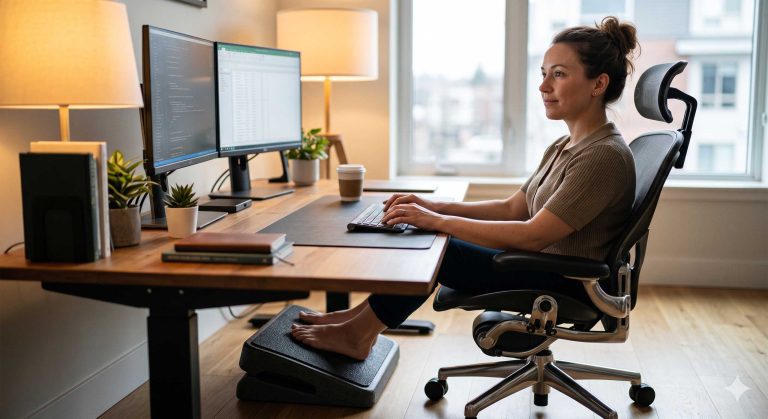
Grounded Stability: Foot support anchors the lower body, encouraging workers to lean back into the chair’s lumbar support.
Research published in ScienceDirect found that an angled footrest under a desk increased workers’ use of their chair’s backrest, and therefore had the potential to reduce biomechanical loads on the spine during computer work. The authors noted this makes footrests worth considering not just for people with height-related anthropometric differences, but as a broader ergonomic intervention for back discomfort.
Who Benefits Most From Using a Footrest?
Footrests are most commonly recommended for shorter desk workers whose feet don’t comfortably reach the floor when the chair is at the right height. But the benefit isn’t limited to people by height alone.
Anyone who experiences that mid-afternoon lower back ache, whose feet tend to tuck under the chair during the day, or who finds themselves repeatedly shifting position trying to get comfortable, may find that a footrest changes things noticeably. Chiropractors who work with desk workers note that footrests encourage what they call “active sitting,” allowing the hip joint and lumbo-pelvic region to shift positions occasionally, rather than locking into one static load pattern for hours.
Choosing and Using a Footrest That Actually Helps
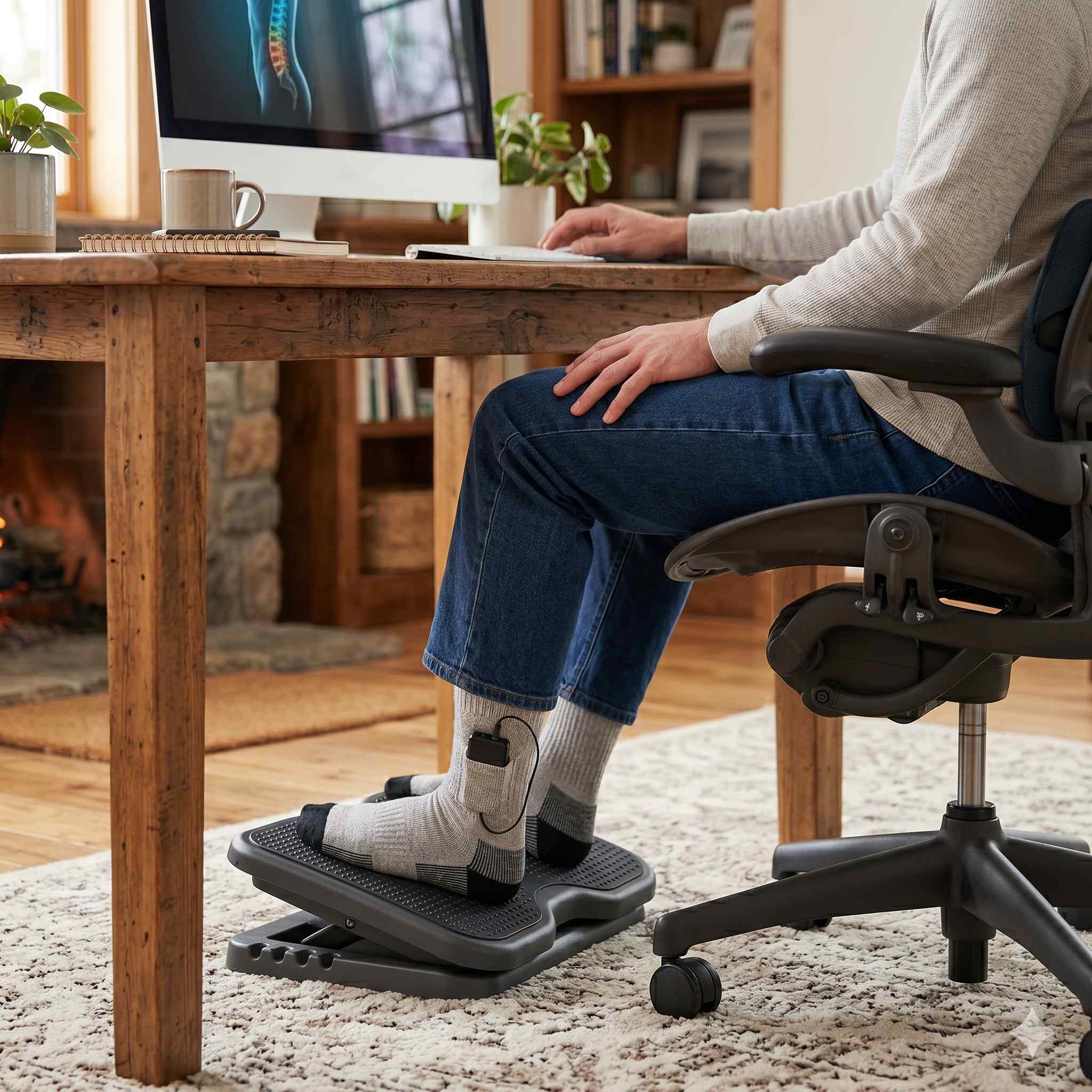
A footrest doesn’t need to be expensive, but a few features matter. Adjustable height is the most important one. Your goal is to position the footrest so that your knees sit at roughly a 90-degree angle (or slightly lower than your hips), with your thighs roughly parallel to the floor. If the footrest is too low, it won’t change your pelvic position enough to make a difference. Too high, and it creates the opposite problem.
| Step | Setup Action | Goal |
|---|---|---|
| 1. Chair Height | Adjust chair so elbows sit level with desk. | Prevents shoulder/wrist strain. |
| 2. Check Clearance | Verify if feet sit flat on floor. | Identifies if a height gap exists. |
| 3. Footrest Position | Place footrest close enough to avoid leg extension. | Maintains 90° knee angle & level thighs. |
| 4. Anchor Posture | Sit back into the chair, making firm backrest contact. | Engages chair lumbar support. |
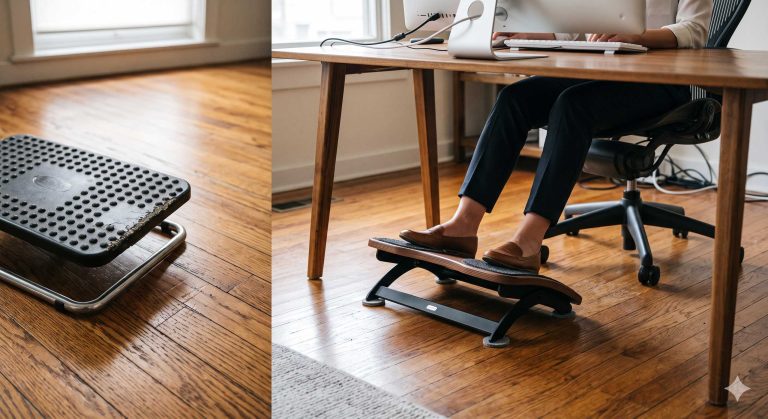
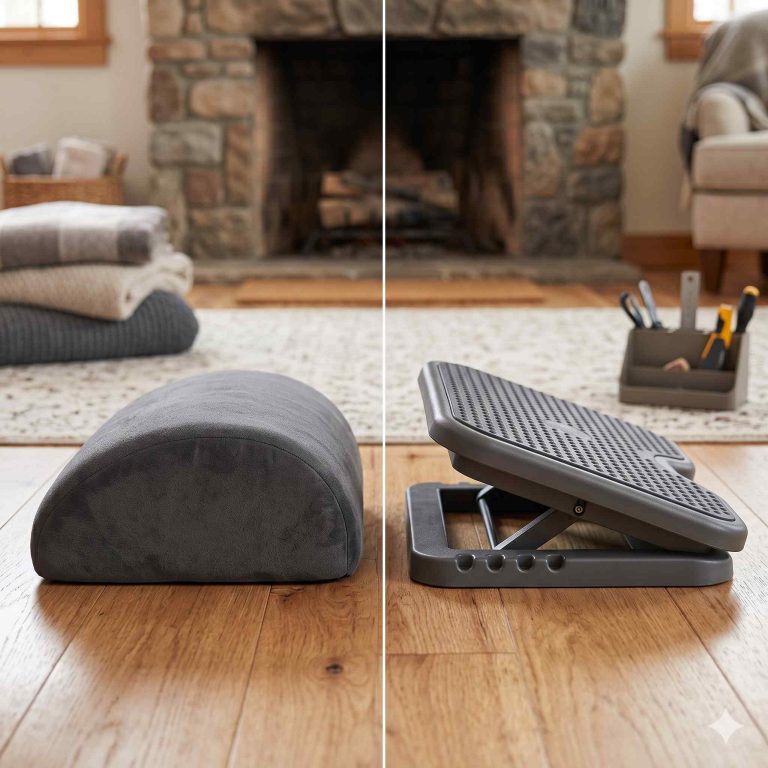
A slight tilt angle on the footrest surface (rather than a flat platform) is often better for comfort over long periods, as it allows a more natural foot position and encourages small weight shifts throughout the day. Some footrests have a rocking or pivoting surface for this reason.
Key Takeaways
- Foot grounding directly affects pelvic posture; unsupported feet lead to posterior pelvic tilt and flattened lumbar lordosis.
- Elevating feet with a footrest shifts hip flexion to promote neutral pelvic rotation, reducing lower back muscle fatigue.
- Footrests eliminate forward perching by providing an anchor, prompting workers to utilize their chair’s lumbar support.
- Tilting or rocking footrest models encourage active micro-movements, preventing static muscle load and stiffness.
- The combination of proper chair height, backrest engagement, and a footrest forms a complete ergonomic system to alleviate spinal load.
Putting It Together
Lower back pain from desk work is rarely about one thing. But the chain from foot position to pelvic stability to lumbar support engagement is a real and well-documented one. When your feet have nowhere to rest, your pelvis tilts, your lumbar curve flattens, your back muscles work harder, and your chair’s built-in support goes unused.
An under-desk footrest is a low-cost way to interrupt that chain. It’s not a substitute for a well-fitted chair or for getting up and moving regularly throughout the day, but paired with those things, it can make a meaningful difference to how your lower back feels by 5 PM. If you haven’t tried one, it’s worth the experiment.
References and Further Reading: PMC – Biomechanical Effects of Different Sitting Postures on the Lumbar Spine; ScienceDirect – The effects of using a footrest during computer tasks (2021); ScienceDirect – Sitting biomechanics Part I: Review of the Literature; PMC – The effect of a lumbar support pillow on posture; PubMed – Biomechanical evaluation of footrest heights (Cregg et al., 2021); Humanscale; Level Up Sports Chiropractic; E3 Ergonomic Consultants.