The Short Person’s Guide to Desk Ergonomics: Why Your Feet Need a Footrest
If you are under 5 feet 6 inches tall, standard office furniture was not designed for you. Learn how bridging the floor gap protects your spine, hamstrings, and long-term seated comfort.
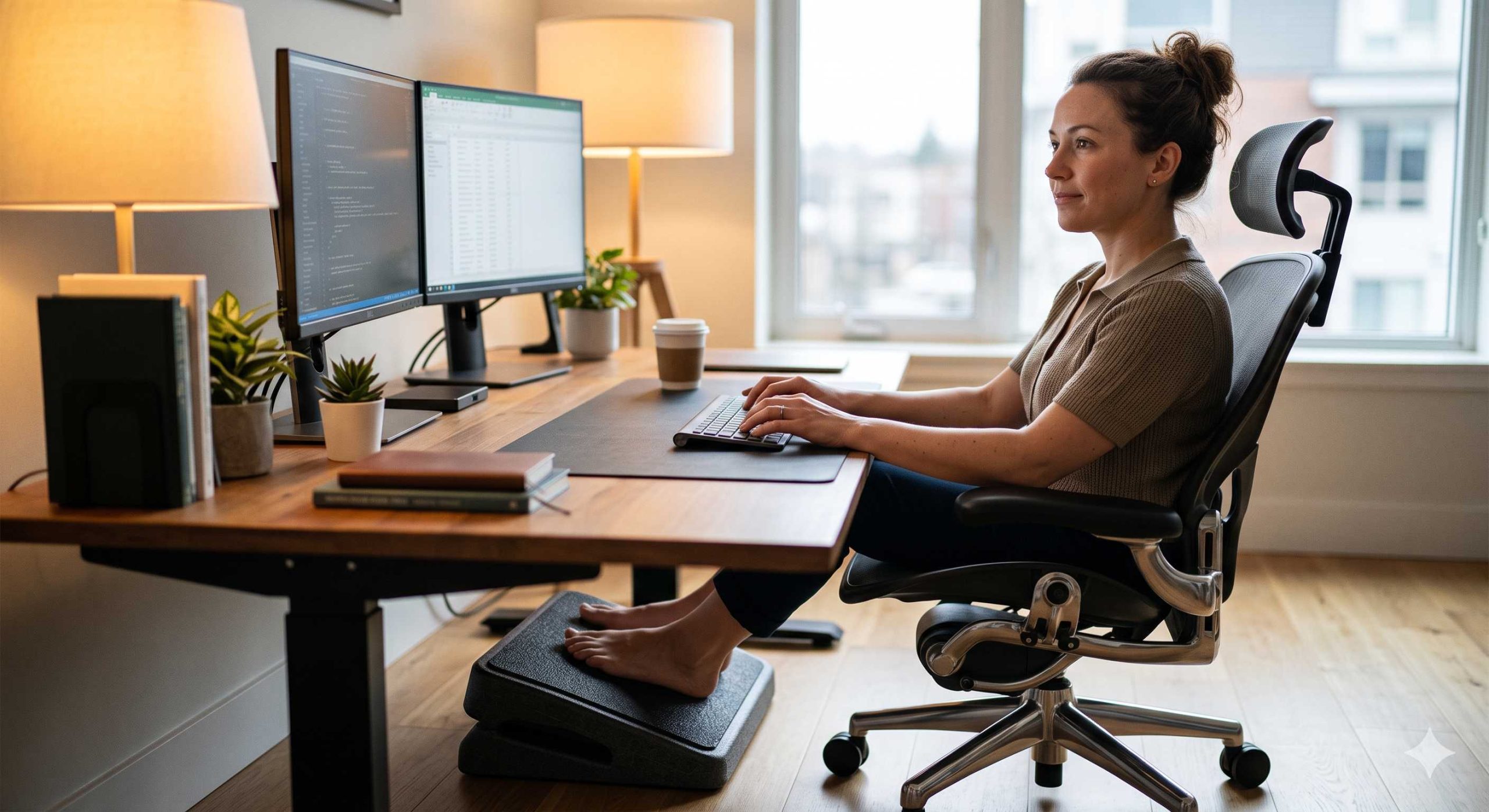
If you are under 5 feet 6 inches tall, standard office furniture was not designed for you. The typical desk stands at a fixed height of 29 to 30 inches, a measurement optimized for a person who is roughly 5 feet 10 inches tall. When a shorter individual sits at a standard desk, they face an annoying dilemma: raise the chair to reach the keyboard comfortably and let their feet dangle, or lower the chair to plant their feet on the ground and strain their shoulders to work.
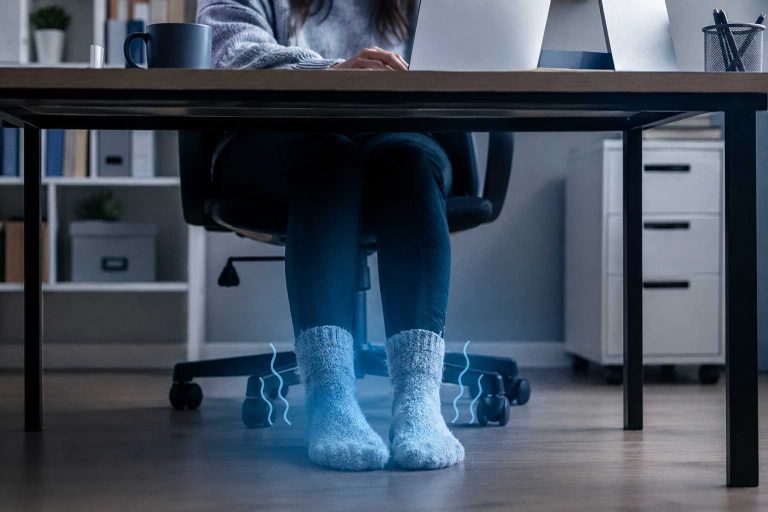
Most people choose to raise the chair. This leaves their feet hovering an inch or two above the carpet or lightly tapping their tiptoes against the floor wheels. While it might seem like a minor inconvenience, the mechanical strain of dangling feet causes a domino effect of physical fatigue throughout the day.
The Mechanical Strain of Dangling Feet
When your feet do not rest flat on a solid surface, the weight of your lower legs pulls downward on the underside of your thighs. This constant downward pull concentrates your entire lower body weight onto the edge of the chair seat.
High-pressure zones behind the knees and along hamstrings constrict blood vessels and nerves, leading to numbness, cold feet, and leg fatigue.
To relieve seat pan pressure, workers unconsciously slide their hips forward, causing the spine to lose its backrest support.
This compression acts like a mini clamp on your blood vessels and nerves, restricting circulation. It explains why your legs might feel numb, tingly, or cold by 2:00 PM. Your body naturally tries to escape this discomfort by sliding forward on the seat pan. You end up slouching, leaning back to find support that is no longer there, and leaving your lower spine to pay the price.
How a Footrest Fixes Pelvic and Spine Alignment
To understand why a footrest matters, look at how the pelvis acts as the foundation for your spine. When you sit with your feet flat and your knees at a 90-degree angle, your pelvis stays in a neutral, upright position. This stacked foundation allows the natural curves of your spine to support your upper body with very little muscular effort.
The Biomechanical Chain Reaction: Dangling feet force the pelvis to tilt backward into a posterior pelvic tilt. This flattens the natural curve of the lower back, forcing lumbar muscles and ligaments to work continuously just to keep you upright.
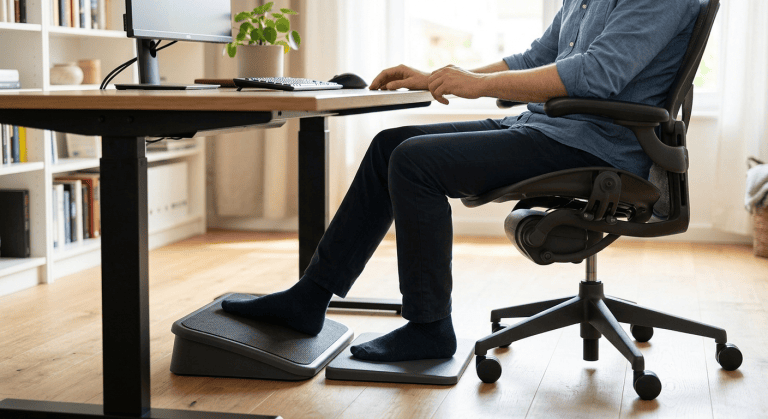
Instead of your sturdy bones supporting your weight, your lower back muscles and ligaments have to work overtime to keep you upright. A footrest acts as an artificial floor. By bringing the ground up to meet your feet, it immediately pushes your pelvis back into its neutral position and restores the healthy curve of your lower back.
Relief for Your Lower Back and Hamstrings
When you use a footrest to establish a solid base, the mechanical stress on your body changes instantly across three primary zones:
- Hamstring Decompression: Lifting your feet removes sharp edge pressure from the seat pan, restoring free blood circulation and reducing deep tissue fatigue.
- Lumbar Load Reduction: A neutral pelvis takes the structural load off lower back muscles, softening that dull mid-afternoon lumbar ache.
- Active Micro-Movements: Models featuring rocking mechanisms or angled surfaces encourage small ankle movements, keeping calf muscles active and pumping blood back to your heart.
Choosing and Setting Up Your Footrest
| Step | Action | Target Alignment |
|---|---|---|
| 1. Adjust Chair | Set chair height relative to your desk. | Elbows at an open 90°–100° angle to the keyboard. |
| 2. Position Footrest | Place footrest under desk and clear all clutter. | Feet rest fully flat without reaching or stretching. |
| 3. Fine-Tune Height | Raise or lower platform settings. | Knees rest level with or slightly higher than hips. |
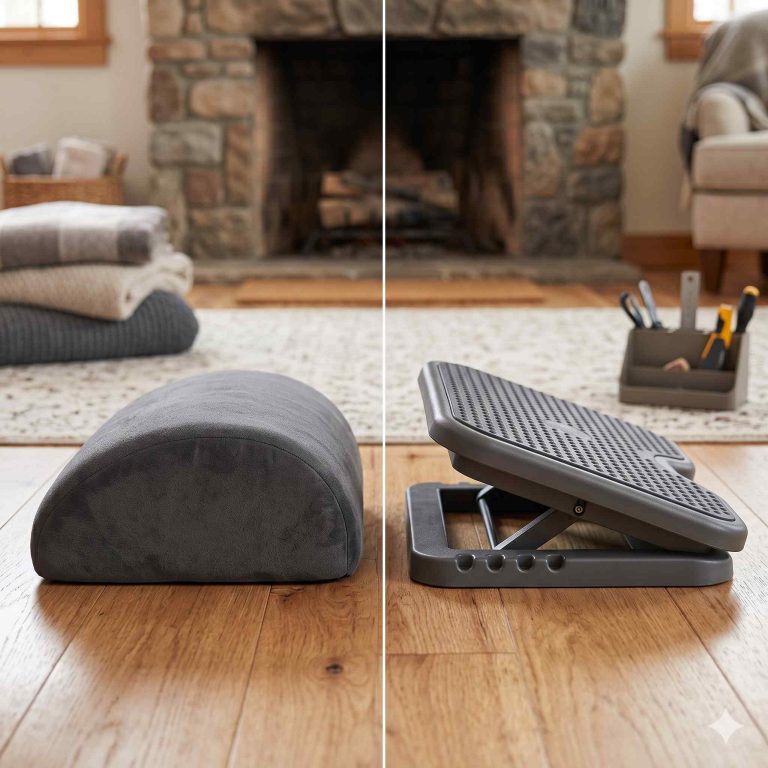
Look for a footrest that offers height adjustments so you can fine-tune it to your specific chair settings. A non-slip surface is essential to keep your shoes from sliding around. Some users prefer memory foam models for barefoot comfort, while others like rigid plastic or wooden models that offer a firm, stable platform.
Key Takeaways
- Standard desk heights (29″–30″) cater to individuals ~5’10”, forcing shorter workers (under 5’6″) into posture trade-offs.
- Dangling feet cause seat pan compression on the hamstrings, restricting blood flow and triggering tingly, cold legs.
- Raising the floor with a footrest prevents posterior pelvic tilt, naturally restoring healthy lower back lumbar lordosis.
- Proper foot grounding allows desk workers to fully sit back and engage their chair’s built-in lumbar support.
- Correct setup requires keeping knees level with or slightly higher than hips while maintaining a 90°–100° elbow angle at the desk.
Conclusion
Ergonomics is about modifying your environment to support your body, not forcing your body to adapt to a poorly sized desk. For professionals under 5 feet 6 inches, a footrest is a vital ergonomic tool that corrects pelvic alignment and stops lower back strain.
By bringing the floor up to meet your feet, you remove the mechanical strain on your hamstrings and give your spine the stable foundation it needs to work without pain. Take a look under your desk today. If your feet are searching for the floor, it is time to add a footrest to your workspace setup.
References and Resources: Human Factors and Ergonomics Society (HFES): Guidelines for standard BIFMA furniture dimensions and anthropometric data; Occupational Safety and Health Administration (OSHA): Computer Workstations eTool on proper foot support; Cornell University Ergonomics Web (CUErgo): Research on seating, pelvic tilt, and foot support to mitigate thigh compression.