Should a Footrest Be Flat or Angled? Here’s What Actually Matters
Both work. Neither is automatically wrong. The real answer depends on what your feet are doing all day and how your desk is set up.
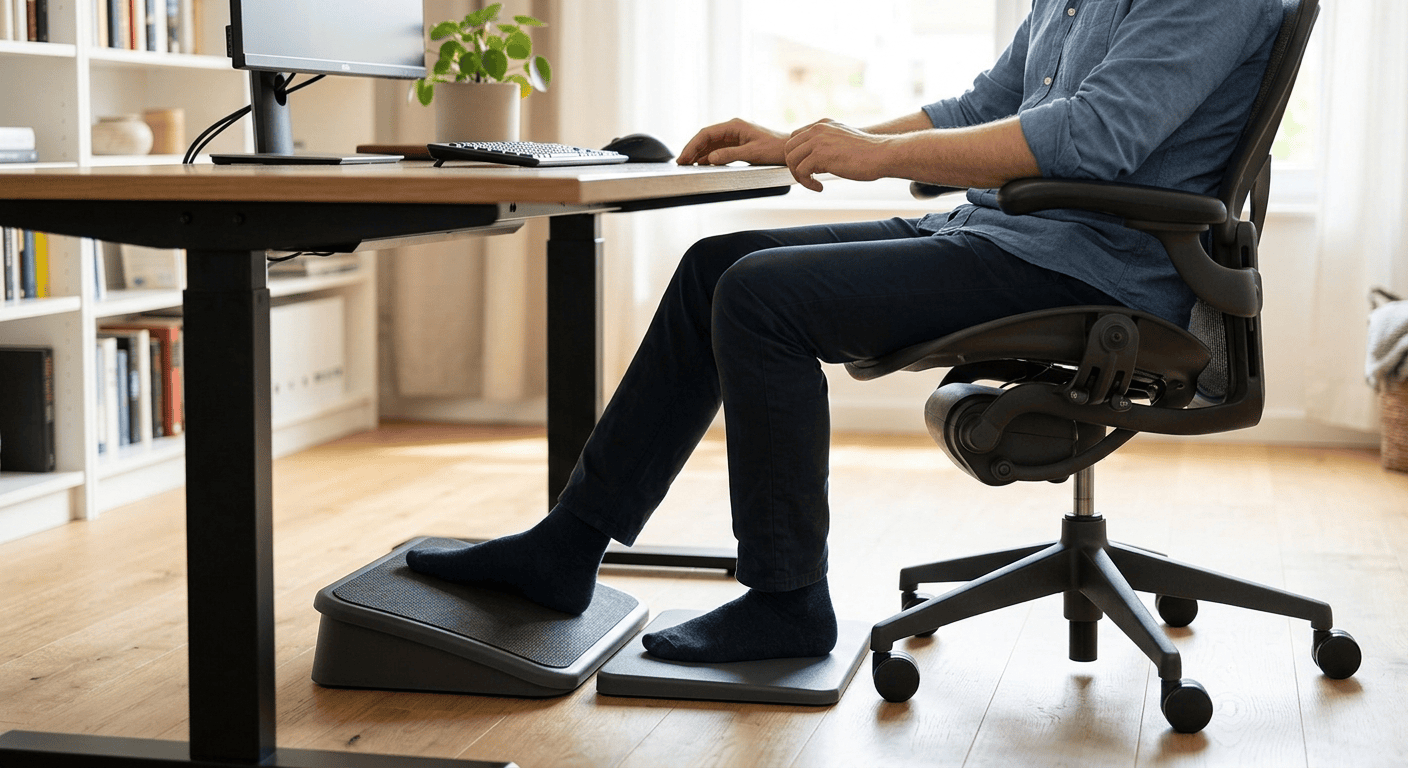
Flat or angled, the right footrest closes the gap between your chair and the floor.
If you’ve been shopping for a footrest, you’ve probably noticed the split pretty quickly. Some are flat, basically a raised platform. Others tilt or rock, letting your foot sit at an angle instead of straight down. And somewhere in the product descriptions or reviews, someone always claims one is objectively better than the other.
It isn’t that simple, and it isn’t supposed to be. A flat footrest and an angled one solve slightly different problems. The right one for you depends less on which is “better” in general and more on how you sit, how long you sit, and what your legs and feet feel like by 3 p.m. on a Wednesday.
This piece walks through the actual difference between the two, why angle changes how your foot and ankle behave over hours of sitting, and how to figure out which setup fits your desk, your chair, and your own body. No universal winner here, just a clearer way to think about the choice.
Flat vs. Angled: The Basic Difference
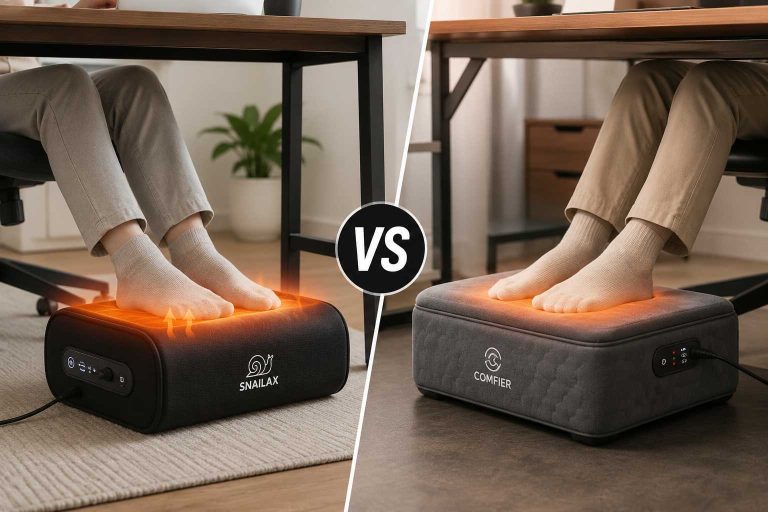
A flat footrest is exactly what it sounds like. It’s a level surface, usually a few inches off the floor, that your feet rest on. Your foot sits parallel to the ground, more or less the same position it would be in if you were standing on a low step.
An angled footrest tilts, either at a fixed slant or on a rocking base that shifts as you move. The front edge sits higher or lower than the back, so your foot rests at a slight incline instead of flat. Some angled models lock into one position. Others rock freely, letting you change the angle just by shifting your weight.
There’s also a middle category worth mentioning: adjustable footrests that let you set the angle yourself and lock it in place. These try to give you the stability of a flat platform with the option to tilt it when you want to.
Flat means your foot stays in one static position. Angled means your ankle gets some range of motion, either fixed at a tilt or free to rock. That range of motion is really the whole debate.
Why the Angle Actually Matters
Here’s the part that gets skipped in a lot of buying guides: the angle isn’t really about the footrest itself. It’s about what your ankle is doing while you sit.
When your foot rests flat on a level surface for hours, your ankle stays in roughly the same position the entire time. That’s not dangerous or harmful, but it’s also not how ankles are built to spend a whole workday. Feet and ankles are used to small, constant adjustments, shifting weight, flexing slightly, rolling side to side, the kind of movement that happens naturally when you’re standing or walking. Sitting removes almost all of that.
An angled or rocking footrest brings a little of that movement back. As you shift your foot position throughout the day, even slightly, your calf muscles and the small stabilizing muscles around your ankle stay a bit more active than they would on a completely static surface. Some people notice this as less stiffness by the end of the day. Others don’t notice much difference at all, particularly if they already get up and move around often.
What’s Actually Happening at the Ankle
When your ankle sits at a slight upward tilt, roughly the range you’d get from a footrest angled between 15 and 25 degrees, your calf gets a gentle, passive stretch instead of staying in a neutral, relaxed position all day. That’s a mild version of what happens when you point your toes up while stretching before a run, just much less intense and sustained over a longer period.
A flat footrest doesn’t offer that stretch. It’s not doing anything wrong, it’s just neutral. For a lot of people, especially those who already move around during the day or don’t sit for long uninterrupted stretches, neutral is perfectly fine.
Why Rocking Footrests Get Talked About So Much
Rocking footrests come up more often in reviews than either flat or fixed-angle models, and there’s a reason for that beyond marketing. A rocking platform doesn’t lock your ankle into one angle at all. Instead, it responds to small shifts in your weight, letting you roll slightly forward or back without much conscious effort.
That constant low-level adjustment is closer to what your feet would naturally do while standing than either a flat surface or a fixed tilt. You’re not deciding to move your foot every few minutes. It just happens as part of sitting normally. Some people find this genuinely helpful when their legs start feeling restless by mid-afternoon. Others find the movement distracting at first, especially in the first day or two, and end up preferring the predictability of something that doesn’t shift under them.
It’s worth being honest that this is one of those areas where personal preference plays a bigger role than any strict ergonomic ranking. Two people with nearly identical desk setups can have completely opposite reactions to the same rocking footrest.
Flat vs. Angled, Side by Side
Rather than declaring a winner, it helps to see where each one tends to shine and where it falls short.
| Factor | Flat Footrest | Angled Footrest |
|---|---|---|
| Stability | Very stable, no wobble | Slight movement, some rocking models more so than fixed-angle ones |
| Ankle movement | Minimal, foot stays static | Encourages small, regular shifts in position |
| Best for | Short sitting sessions, users who move often, typing-heavy tasks needing a firm base | Long sitting stretches, users who sit mostly still, home office setups |
| Learning curve | None, works like a step | Takes a day or two to get used to the tilt or rock |
| Common complaint | Feet feel “locked” in one spot after hours | Feels unstable at first, or too soft on rocking models |
| Price range | Usually lower | Slightly higher for adjustable or rocking versions |
Neither column is the “correct” one. A developer who’s up and pacing during calls every hour might genuinely prefer flat, simple stability with nothing to think about. Someone doing four hours of uninterrupted data entry might get more out of an angled model that keeps their ankle from locking up.
So What’s the Best Angle, If You Go That Route?
If you decide an angled footrest makes sense for you, the range most ergonomic references point to is somewhere between 15 and 25 degrees of tilt. That’s enough to relax the ankle and encourage a small stretch without pushing your foot into an uncomfortable incline.
Steeper angles, anything much past 25 to 30 degrees, tend to put more strain on the front of the ankle rather than relieving it, especially if you’re resting your foot there for hours rather than adjusting it periodically. That’s one of the more common mistakes with adjustable models: people crank the tilt up assuming more angle equals more benefit, when really it just shifts the discomfort somewhere else.
Rocking footrests sidestep some of this because you’re not locked into one fixed degree. You naturally settle into whatever angle feels comfortable in the moment and shift it as you go. That’s arguably the most forgiving option if you’re not sure what angle actually works for your body, since you’re not committing to a single setting.
There isn’t a single research-backed “perfect” angle that applies to everyone. Leg length, chair height, and how your ankle naturally sits all shift what feels right. The 15 to 25 degree range is a reasonable starting point, not a strict rule.
Who Benefits From Which Style
This is where a lot of the flat-versus-angled debate actually resolves itself. It’s less about which is objectively better and more about matching the footrest to how you actually work.
None of this is a hard rule. Plenty of people try one style, don’t love it, and switch. That’s a normal part of figuring out what actually works for your own setup rather than a sign you bought the wrong thing.
Setting Your Footrest Up Correctly
Whichever style you land on, how you set it up matters more than which one you picked. A poorly positioned angled footrest can feel worse than a well-positioned flat one, and vice versa.
- Start with your chair, not the footrest. Get your chair height set so your elbows sit comfortably at desk level first. Don’t use the footrest to compensate for a chair that’s simply too high for typing comfort.
- Check your knee angle. Once your chair is set, your knees should land somewhere between 90 and 110 degrees. Sharply bent knees usually mean the footrest is positioned too close or too tall.
- Slide the footrest until your thighs sit level. You’re aiming for thighs roughly parallel to the floor, or angled slightly down from hip to knee, not up.
- If it’s angled, start on the lower end of the tilt. Begin closer to 15 degrees rather than 25 and adjust from there. It’s easier to increase the angle than to walk back from something too steep.
- Give it a real trial, not twenty minutes. Your body needs a day or two to adjust to a new foot position, especially with a rocking or angled model. Judging it after one short session usually isn’t a fair test.
Mistakes Worth Avoiding
A few patterns show up again and again with footrest setups, regardless of which style someone picks.
- Setting it too high. This pushes your knees above your hips, which usually creates more discomfort than it solves, angled or flat.
- Going straight to a steep angle. More tilt isn’t automatically better. Start low and adjust gradually if your model allows it.
- Ignoring seat depth. If your chair seat is pressing into the back of your knees, no footrest, flat or angled, is going to fix that on its own.
- Staying locked in one position all day anyway. Even an angled footrest won’t help much if you never shift your foot or take a break to stand. The footrest supports movement, it doesn’t replace it.
- Buying based on reviews for a completely different body type or desk setup. A rocking footrest that a 6’2″ reviewer loves might feel completely different under a 5’2″ frame with a much shorter leg length.
- Overlooking surface texture. A smooth plastic surface can feel slippery in socks, especially on a rocking or angled model where your foot is already shifting position. A textured or slightly ridged surface keeps your foot from sliding forward as the angle changes.
- Assuming the footrest has to be used all day, every day. Some people do fine using it only during longer stretches of focused work and skipping it during shorter tasks. There’s no rule that says it has to stay under your feet the entire shift.
Most of these mistakes share a common thread: treating the footrest as something to set once and forget about, rather than something to check in on periodically. A setup that felt right in January might need a small adjustment after switching to a new chair or desk in the spring.
Are Adjustable Footrests Worth the Extra Cost?
Adjustable and rocking footrests usually cost more than a basic flat platform, sometimes twice as much. Whether that’s worth it depends on how confident you are about what your body actually needs.
If you already know you sit still for long stretches and tend to feel stiff by the afternoon, an adjustable or rocking model is a reasonable investment since you’re solving a problem you’ve already identified. If you’re not sure yet, and this is your first footrest, a simpler flat or lightly angled fixed model is a lower-risk way to figure out whether foot support helps you at all before spending more on something adjustable.
There’s also a practical middle ground: footrests with a fixed angle that isn’t adjustable but also isn’t flat, usually sitting around 15 to 20 degrees. These cost close to what a flat model does but give you some of the ankle movement benefit without the higher price of a fully adjustable rocking base.
Footrests, Posture, and Everyday Comfort
A footrest, angled or flat, plays one specific role in how you sit: it helps keep your thighs and pelvis in a more neutral position when your chair and desk height don’t naturally line up with your leg length. That neutral position tends to make it easier to sit comfortably for longer without sliding forward, slouching, or perching on the edge of your seat.
It’s worth being realistic about what that does and doesn’t mean. A footrest can make sitting for long stretches feel noticeably more comfortable, but the height and fit of your chair and desk matter just as much, sometimes more. If your chair is fundamentally the wrong height for your desk, a footrest helps close that gap, but it isn’t rebuilding your entire workstation on its own.
The angle piece adds a comfort layer on top of that. Because it encourages small, natural shifts in foot position rather than one static pose held for hours, some people find their legs feel less “stuck” by the end of the day. That’s a comfort observation more than anything else, and it varies a lot from person to person depending on how much you already move during work hours.
It also helps to separate what a footrest is doing from what the rest of your setup is doing. Monitor height, chair depth, and how often you get up and walk around all play their own part in how your body feels after a full day at a desk. A footrest is one variable among several, not the single factor that determines whether sitting feels comfortable or not. Treating it that way sets more realistic expectations than expecting one accessory to offset everything else about a workstation that doesn’t fit you well.
Gamers, Students, and Other Long-Session Use Cases
Outside of the standard office desk scenario, footrests show up a lot in gaming setups and study spaces, and the flat versus angled question plays out a little differently there.
Gaming sessions often run longer and more uninterrupted than a typical office workday, since there’s rarely a meeting or a coffee run breaking things up. That tends to make angled or rocking footrests a more popular choice in gaming setups, simply because there’s more continuous sitting time for the ankle movement to matter.
Students studying at a desk for hours face a similar pattern, especially with laptop setups where the desk height isn’t adjustable and a chair borrowed from a dining set doesn’t match. In these cases, getting the basic height right, flat or angled, usually matters more than which specific style is chosen.
If you move around often, take frequent breaks, or just want something simple and stable, flat works fine. If you sit for long, uninterrupted stretches and want a bit of built-in ankle movement, an angled or rocking model is worth trying. Neither one is a mistake. The bigger factor, in both cases, is getting the height and position right, which matters more than the angle debate itself.
Key Takeaways
- Flat footrests offer a stable, static surface, ideal for people who move around often during the day.
- Angled footrests encourage small, ongoing ankle movement, which tends to suit long, uninterrupted sitting sessions better.
- A 15 to 25 degree tilt is a reasonable starting range for angled models, not a strict rule everyone needs to follow.
- Getting the footrest height right matters more than choosing flat versus angled. Wrong height undercuts either style.
- Rocking footrests let you settle into your own comfortable angle rather than locking into one fixed setting.
- There’s no universal winner. The right choice depends on how long you sit, how often you move, and your own leg length and chair setup.
FAQ
Should a footrest be flat or angled?
What is the best footrest angle for an office chair?
Are adjustable footrests worth the extra cost?
Can a footrest improve posture?
Do rocking footrests actually help, or is that just marketing?
Is a flat footrest bad for posture?
How do I know if my footrest angle is too steep?
Do I even need a footrest if my feet already reach the floor?
Is it normal for an angled footrest to feel odd at first?
Can I switch between flat and angled depending on the task?
Final Thoughts
The flat versus angled question doesn’t really have a universal answer, and any guide that tells you otherwise is oversimplifying it. What matters more is being honest about how you actually sit. If you’re up and moving through the day, a flat footrest is a perfectly reasonable, low-maintenance choice. If you’re parked in one spot for hours at a stretch, an angled or rocking model gives your ankle something to do besides stay still.
Get the height right first. That’s the part that actually determines whether a footrest helps at all, and it matters more than whichever angle debate you land on. Once the height is dialed in, choosing between flat and angled comes down to trying one, paying attention to how your legs feel by the end of the day, and adjusting from there.
References & Further Reading
- OSHA, Computer Workstations eTool, Workstation Environment guidance
- Cornell University Ergonomics Web, seated workstation and footrest guidelines
- Mayo Clinic, Office ergonomics: Your how-to guide