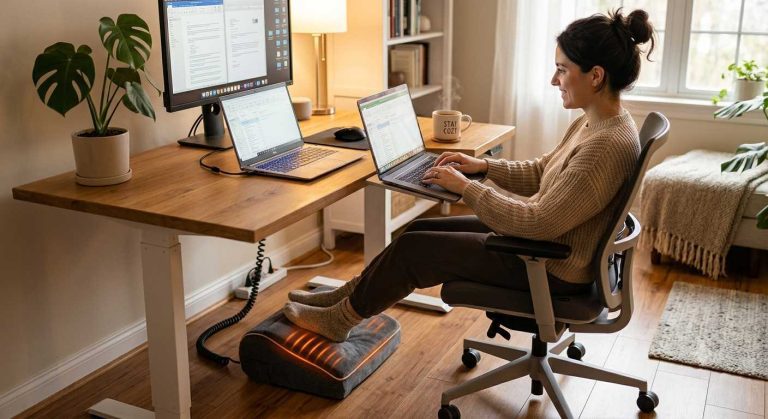
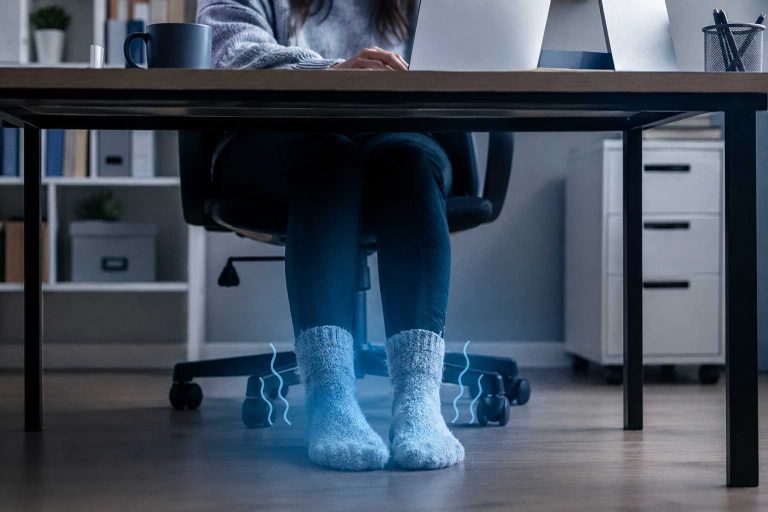
Can You Use a Regular Heating Pad as a Foot Warmer?
Tossing a standard heating pad on the floor to warm freezing feet seems like an easy shortcut. Here is why internal wiring design and concentrated body weight make this a serious hazard—and what purpose-built foot warmers do differently.

It’s the kind of shortcut that makes sense on paper. You already own a heating pad for your back or shoulders, your feet are freezing under the desk, so why not just toss it on the floor and stand on it?
The honest answer is that you can plug in almost anything and call it a foot warmer, but whether you should is a different question entirely. It comes down to two things: how these products are physically built, and what happens when concentrated weight meets thin internal wiring. This article looks at what’s actually inside a standard heating pad, why manufacturers print warnings against sitting or standing on them, and what separates a genuine foot warmer from a repurposed back pad.
How a Standard Heating Pad Is Actually Built
Most consumer heating pads use a network of thin resistive wires sandwiched between layers of fabric or a flexible PVC sheet. The wire itself is often barely thicker than a strand of hair-fine copper, looped back and forth across the pad in a pattern designed to spread heat evenly. That design works well when the pad is draped over a shoulder or laid flat under a forearm, because the pressure involved is light and distributed.
It was never engineered with standing weight in mind. A heating pad manufacturer instruction sheet reviewed for this article states plainly: do not sit on, or against, or crush the pad, and avoid sharp folds entirely. Similar wording shows up across nearly every brand on the market, with companies like Bedsure instructing users to avoid placing heavy objects on the pad during use, and Sunbeam’s customer support confirming directly that they do not recommend sitting or lying on the heating pad, partly because the surface needs room for air to circulate to reduce the risk of burns and electric shock.
Manufacturer Warning Pattern: Virtually all standard heating pad manuals explicitly forbid sitting, lying, or stepping on the pad. Standing traps heat and creates extreme mechanical pressure on ultra-thin internal resistive wires.
What Happens When Weight Is Concentrated Through Standing
Lying back against a heating pad spreads your body weight across a broad area. Standing does the opposite. A person’s full weight, often 60kg or more, gets funneled through two relatively small footprints, and that weight shifts constantly as you balance, walk on the spot, or rock your feet. This is a fundamentally different kind of mechanical stress than the pad was designed to absorb.
Folding or bunching internal wiring under foot pressure causes local temperatures to spike to roughly three times calibrated levels within minutes as heat cannot dissipate.
Repeated stepping crushes delicate copper strands at seam joints, causing unseen insulation damage, hot spots, and electrical short circuits.
Damaged insulation doesn’t always announce itself. Sometimes the first sign is a hot spot—a patch noticeably warmer than the rest of the pad, especially near a seam or where the controller cord connects. Other warning signs include a controller that feels warm to the touch when it should stay cool, or any burning smell while the pad is in use.
The Fire Risk Is Not Theoretical
This isn’t an abstract worry. Heating pads and electric blankets are linked to around 500 house fires annually in the United States, and the vast majority of those incidents involve units that are more than ten years old. The U.S. Consumer Product Safety Commission has issued multiple recalls in recent years for heating pads and blankets where internal controller faults led to overheating, melting, and in some cases actual fires.
One 2023 recall covering roughly 350,000 units cited 137 reports of pads catching fire, melting, or overheating in people’s homes, including 17 burn injuries. A separate 2025 recall involved 34 reports of overheating tied to one model line, three of which resulted in burn injuries.
None of these recalls were specifically about foot use. But they illustrate how quickly a wiring fault inside one of these products can escalate, and standing on a pad introduces exactly the kind of mechanical stress that accelerates wire fatigue. Combine that with covering the pad (your feet do exactly that) and you’re stacking two risk factors that safety bodies specifically warn against.
So What’s Actually Different About a Purpose-Built Foot Warmer
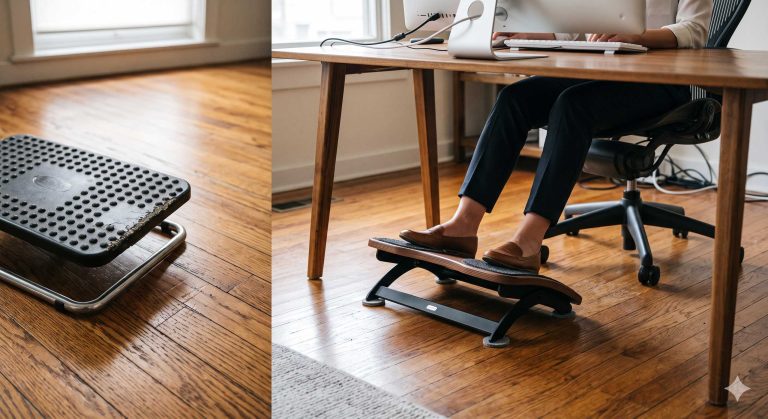
Foot warmers designed for the job aren’t just a heating pad with a different label glued on. They are engineered from the inside out to handle continuous weight and foot contact.
| Design Aspect | Standard Heating Pad | Purpose-Built Foot Warmer |
|---|---|---|
| Structural Frame | Flexible fabric or thin PVC sheet | Rigid or reinforced semi-rigid shell base |
| Wiring Placement | Sandwiched directly under skin/foot contact | Suspended or embedded above point of pressure |
| Weight Tolerance | Zero (Light, distributed contact only) | Certified to absorb full downward foot pressure |
| Thermal Airflow | Requires open surface air circulation | Enclosed or insulated to prevent thermal runaway when covered |
This is the practical distinction worth remembering: weight tolerance isn’t a feature that’s simply “extra” on a foot warmer, it’s the entire reason the internal construction is different in the first place. A flat heating pad, no matter how well made, was never tested or certified against that kind of load.
A Few Practical Takeaways
If your feet get cold and you’re eyeing the heating pad in the cupboard, a few simple swaps reduce most of the risk:
- Drape, Don’t Step: Keep standard pads for their intended purpose—draped loosely over your lap or feet while sitting, rather than underfoot while standing.
- Use Purpose-Built Products: If you need something to stand or step on, look for a product explicitly marketed and certified as a heated foot mat or under-desk foot warmer.
- Inspect Before Use: Regularly check cords, seams, and fabric for discoloration, fraying, or scorch marks.
- Never Leave Unattended: Turn off and unplug all heating elements when leaving your workstation or going to sleep.
Key Takeaways
- Standard heating pads use hair-fine copper wires designed exclusively for light, distributed pressure—not standing weight.
- Concentrated pressure from standing causes wire bunching, spiking local temperatures to 3x calibrated levels and frying insulation.
- Electric heating devices cause ~500 fires annually in the U.S.; standing on pads accelerates the exact wire fatigue that triggers shorts.
- Dedicated foot warmers utilize rigid bases, suspended wiring, and heat-dissipating shells built for stepping and resting feet.
- Never sit or stand on a standard heating pad; drape them loosely, or upgrade to a certified heated foot mat.
Wrapping Up
Standard heating pads are built for light, distributed contact, not for absorbing the concentrated and shifting weight of a standing body. Manufacturer instructions consistently warn against sitting or standing on them, and the reasoning lines up with how the internal wiring is laid out and how heat-related fires typically start.
If cold feet are the actual problem you’re solving, a dedicated foot warmer designed to handle standing weight is the safer route, and honestly, probably the more comfortable one too. Worth checking your current heating pad’s manual before your next cold morning, just to see what it actually says.
References: U.S. Consumer Product Safety Commission (CPSC) Bedsure & MaxKare Recalls; Electrical Safety Foundation International (ESFI) Heating Pad Safety; Mattressnut Electric Blanket Safety (2026); Rehabmart XL Heating Pad Instructions; Bedsure Setup Guide; Sunbeam Customer Service Q&A.