What Is the Purpose of a Footrest? A Complete Guide to Ergonomic Foot Support
A footrest exists to support your feet when they can’t comfortably reach the floor, and to take pressure off your legs, hips, and lower back during long stretches of sitting. That’s the short answer. This guide covers the longer one.
If you’ve ever sat at a desk and noticed your feet dangling, your thighs pressing hard into the front of the chair, or a dull ache creeping into your lower back by mid-afternoon, you already understand the problem a footrest is trying to solve. Whether it’s actually worth adding to your setup depends on your chair height, your desk height, your own height, and how long you sit still each day.
What Is a Footrest, Exactly?
A footrest is a raised platform, typically placed under a desk, that supports the feet when sitting. It ranges from a simple angled block of foam to a motorized platform with heating, massage rollers, and adjustable tilt. At its simplest, it’s just something to put your feet on so they’re not hanging in midair or resting flat on a floor that’s slightly too far below your chair. That sounds basic, but foot position turns out to be one of the more overlooked pieces of desk ergonomics.
Static tilting footrests: a fixed platform, often rocking or tilting, that lets you shift your foot angle.
Adjustable height footrests: platforms you can raise or lower to match your chair and desk.
Under-desk cushions or wedges: softer, simpler versions meant mainly for comfort rather than active movement.
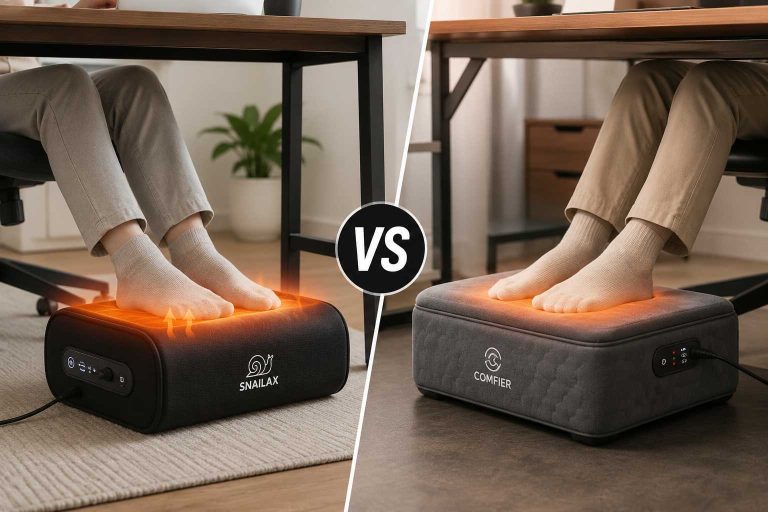
Heated or massage footrests: electric models that add warmth or vibration, more common at home than in corporate offices.
Each type serves the same underlying purpose, just with different levels of adjustability and added features. A $15 foam wedge and a $150 heated massage footrest are solving the same basic problem, one just does more along the way.
The Core Purpose of a Footrest
The main job of a footrest is simple: it gives your feet a stable, supported surface when the floor isn’t in the right place relative to your chair and desk. That happens more often than you’d expect. Office chairs and desks are usually built to standardized dimensions, with desk height in most workplaces sitting around 28 to 30 inches. If you’re average or above-average height, this works out fine. If you’re shorter, or your desk can’t be lowered enough, the math doesn’t work in your favor.
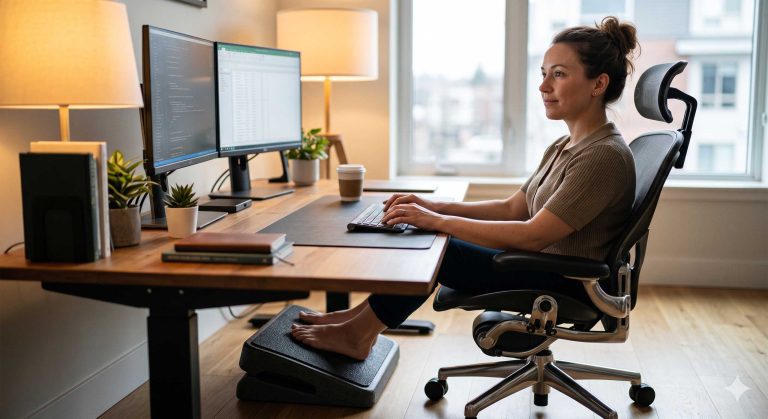
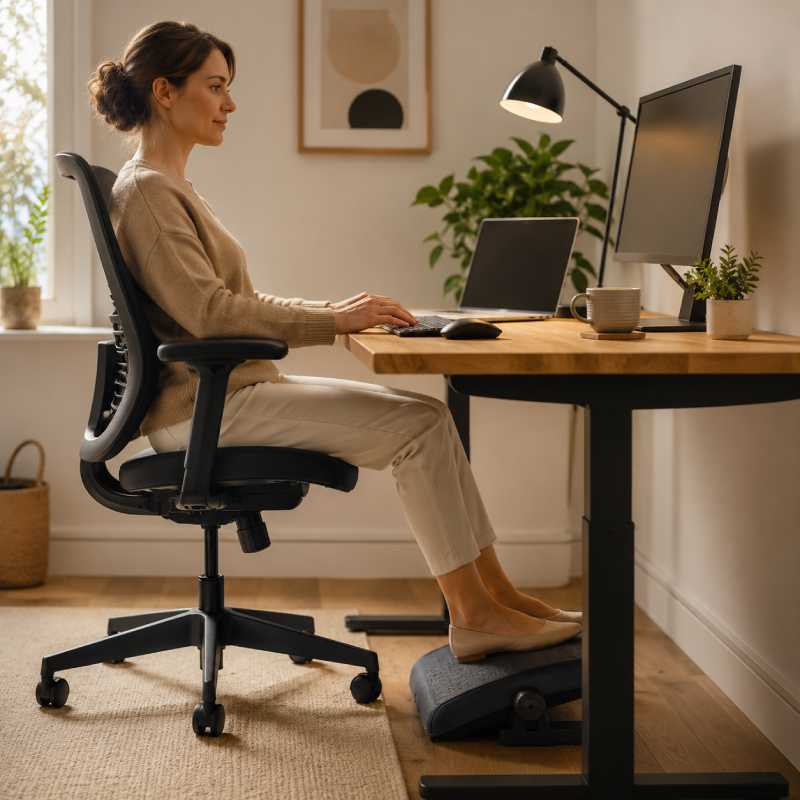
A footrest closes that gap, essentially bringing the floor up to meet your feet, so your thighs stay roughly parallel to the ground and your knees sit at something close to a 90-degree angle, the position most ergonomic guidelines point to as a reasonable starting point.
Beyond filling a height gap, a footrest also gives you somewhere to shift your feet during the day. Sitting still for hours isn’t great for circulation, and a tilting or rocking footrest gives your ankles and calves small, low-effort movements that a flat floor doesn’t really invite. It’s a small thing, but it adds up over a workday.
The Ergonomic Case for Footrests
Ergonomics is about matching your environment to your body rather than forcing your body to adapt to a one-size-fits-all setup. A footrest fits directly into that idea.
Why Foot Position Affects the Rest of Your Posture
Your feet are the base of your seated posture, even though it’s easy to overlook them in favor of your back or your screen height. When your feet aren’t properly supported, a few things tend to happen:
- Your thighs press into the front edge of the seat, which can restrict circulation behind the knees
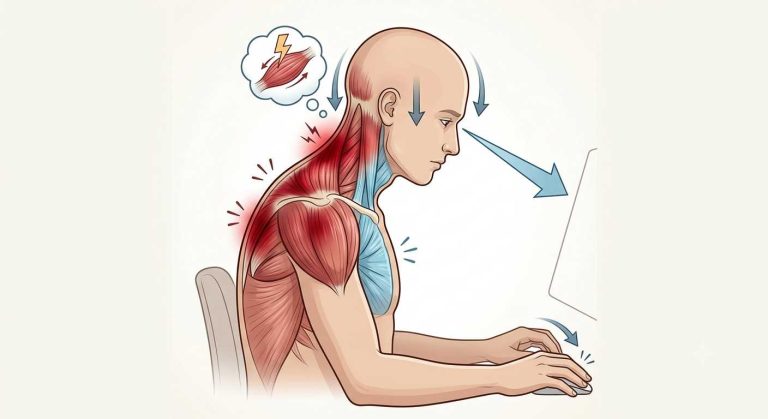
- Your pelvis tilts, which changes the natural curve of your lower spine
- You start compensating by slouching, crossing your legs, or perching on the edge of the chair
None of these are dramatic on their own. But stacked up over a full workday, five days a week, they contribute to the familiar stiffness and fatigue a lot of desk workers deal with by late afternoon. A footrest, set at the right height, keeps your knees at roughly hip level or slightly below, allowing your pelvis to sit in a more neutral position, one of the building blocks ergonomic specialists point to when discussing spinal alignment while seated.
The Angle Matters as Much as the Height
This is where a lot of people get it wrong. It’s not just about having something under your feet, it’s about the angle of that surface. A flat platform is better than nothing, but a slightly tilted one, usually somewhere between 15 and 25 degrees, lets your ankle rest in a more relaxed position instead of forcing your foot flat. Rocking or rolling footrests take this further by letting you shift the angle throughout the day rather than locking your foot into one static position for hours.
Do Footrests Help With Lower Back Pain?
Short answer: A footrest can help reduce lower back discomfort caused specifically by poor seated posture, particularly when your feet don’t reach the floor. It is not a cure for back pain in general.
By supporting proper alignment between your pelvis, hips, and spine, a footrest removes one contributing factor to that kind of pain. That said, lower back pain has plenty of possible causes: weak core muscles, prior injury, poor mattress support, prolonged inactivity, or issues that have nothing to do with how you sit at a desk. A footrest addresses one specific piece of the puzzle, postural strain from unsupported feet during seated work.
If your back pain stems from something unrelated to foot position, a footrest probably won’t move the needle much. Where footrests tend to make a genuine difference is for people whose pain is linked to sitting with dangling feet, a chair that’s too tall for their frame, or hours of poor pelvic alignment. For persistent or severe back pain, seeing a physical therapist or physician is a more reliable path than betting on a piece of desk equipment to fix it. A footrest is reasonably framed as one part of a broader ergonomic setup, alongside chair height, monitor position, and regular movement breaks, not a standalone solution.
Who Actually Needs a Footrest?
Not everyone needs one. Someone whose feet rest flat on the floor with their knees at a comfortable angle usually doesn’t gain much from adding a footrest, and forcing one into that setup can actually throw off an otherwise fine posture.
Shorter individuals. Under about 5’4″? There’s a decent chance your feet don’t fully reach the floor in a standard chair and desk pairing, even with the chair lowered as far as it goes.
Mismatched desk setups. Standing desks, shared desks, or fixed-height furniture sometimes leave no room to lower the chair enough to compensate.
Dangling feet or seat pressure. A footrest, paired with a properly adjusted seat depth, helps reduce pressure behind the knees.
Long, uninterrupted sitting. A footrest that allows some ankle movement can offset a bit of the postural strain that builds up over time.
Remote workers using makeshift setups tend to benefit too, kitchen tables and dining chairs weren’t designed for eight-hour workdays, and a footrest is often a cheap, immediate way to correct for furniture that’s the wrong height. On the other hand, tall individuals, people with adjustable sit-stand desks set to their exact measurements, or anyone whose current seated posture already feels neutral probably won’t notice much benefit.
Types of Footrests and How They Differ
| Type | Best For | Adjustability | Price Range |
|---|---|---|---|
| Foam wedge / cushion | Casual comfort, budget setups | Low | $15–$30 |
| Static tilting platform | General desk use, all-day support | Medium | $20–$50 |
| Height-adjustable platform | Custom desk/chair combinations | High | $30–$80 |
| Rocking or rolling footrest | Active sitting, circulation | Medium–High | $25–$60 |
| Heated or massage footrest | Home offices, cold environments | High | $60–$150 |
Foam wedges are the simplest option and work fine for people who just need a little lift without much fuss. Tilting platforms add a rocking motion that encourages small ankle movements throughout the day. Height-adjustable models are worth the extra cost if your desk and chair combination is unusually mismatched. Heated and massage footrests are more of a home-office comfort feature than a strict ergonomic necessity, though for people working in cold rooms or dealing with tired feet by evening, the added warmth is a genuine quality-of-life upgrade.
How to Set Up a Footrest Correctly
Getting a footrest is only half the equation. Setting it up wrong can undo whatever benefit it was supposed to provide.
- Adjust your chair height first. Get your chair to a height where your elbows sit comfortably at desk level and your forearms are roughly parallel to the floor. Don’t use a footrest to compensate for a chair that’s set too high for typing comfort.
- Check your knee angle. Once the chair is set, your knees should sit at roughly 90 to 110 degrees, not sharply bent and not fully extended.
- Position the footrest so your thighs stay level. Aim for a thigh position that’s roughly parallel to the floor, or angled slightly downward from hip to knee. Too tall, and it can push your knees above your hips.
- Leave a few inches of clearance under the desk. A footrest that’s too large or positioned too far forward can restrict leg movement rather than support it.
- Test it for a full day before deciding. Posture adjustments often feel slightly off for the first day or two. Give it a genuine trial period rather than judging it after twenty minutes.
Common Mistakes People Make With Footrests
- Setting it too high, which pushes the knees above hip level and can increase pressure on the lower back rather than relieve it.
- Using a footrest too small for the feet. Feet hanging off the edge defeats the purpose and can create new pressure points.
- Ignoring seat depth. A footrest won’t fix the problem if the seat itself presses into the back of the knees.
- Keeping feet locked in one position all day. Rocking or tilting models help, but so does simply changing position periodically.
- Buying based on looks rather than fit. A footrest that photographs well but doesn’t match your actual chair-and-desk height gap isn’t solving anything.
Footrests vs. Other Fixes for Desk Discomfort
A footrest isn’t the only tool for addressing seated discomfort, and it’s worth knowing where it fits relative to the alternatives.
Adjustable desks solve the height mismatch more directly by changing the desk itself, though they’re considerably more expensive and not always an option.
Ergonomic chairs address lumbar support and seat depth, which a footrest doesn’t touch. The two often work best together.
Standing desk converters remove seated posture issues for part of the day, but bring their own considerations around standing fatigue.
Lumbar cushions target the lower back directly, while a footrest addresses posture indirectly through foot and pelvis alignment.
Realistically, a footrest tends to work best as one piece of a broader ergonomic setup rather than a single fix for an uncomfortable workstation. Combining a reasonably supportive chair, a properly set desk height, and a footrest where needed covers more ground than any single item on its own.
Do Footrests Actually Work? Setting Realistic Expectations
For the specific problem they’re built to solve, feet that don’t reach the floor comfortably, footrests generally do what they claim. The improvement in comfort is usually noticeable within days, particularly for shorter individuals or anyone using a desk that can’t be lowered enough.
Where expectations tend to get out of line is when footrests are marketed as broader health solutions. A footrest isn’t going to correct years of poor posture on its own, and it won’t resolve back pain unrelated to foot position or seated alignment. It’s a supporting tool, not a treatment. Results also vary by individual, and for people who already move around a lot during the day, the marginal benefit is smaller than for someone who sits completely still for hours at a stretch.
The honest takeaway is that a footrest is a low-cost, low-risk adjustment worth trying if your feet don’t comfortably reach the floor, with the understanding that it’s addressing one variable in a much larger picture of seated comfort.
Find the Right Fit
Browse footrests with adjustable height, tilt, and heated options for cold home offices.
Shop FootrestsBuying Considerations: What to Look For
- Platform size — comfortably fits both feet without hanging off the edges
- Height range — adjustable models offer more flexibility if you’re unsure what height you need
- Surface texture — a slightly textured or ridged surface helps prevent feet from sliding
- Tilt or rock function — worth prioritizing for long, uninterrupted sitting stretches
- Stability — a non-slip base keeps it from sliding around, especially on hard flooring
- Cleaning and material — fabric is comfortable but harder to keep clean than molded plastic or foam
- Noise — rocking or rolling models can squeak over time, so check longer-term reviews
None of these are dealbreakers on their own, but overlooking two or three of them at once is usually how people end up with a footrest that sits unused in a closet within a month.
Key Takeaways
- A footrest’s core purpose is to support the feet when they don’t comfortably reach the floor, closing the gap between chair height and desk height.
- Proper foot support helps maintain a more neutral pelvis and spine position while seated, the main ergonomic argument in its favor.
- Footrests can ease lower back discomfort linked to poor seated posture, but aren’t a treatment for back pain caused by other factors.
- Shorter individuals, mismatched desk-and-chair setups, and long stretches of sitting tend to benefit the most.
- Tilting or rocking footrests offer more value than flat, static ones by encouraging small, regular movement.
- A footrest works best as part of a broader ergonomic setup, alongside proper chair height, seat depth, and lumbar support.
FAQ
What is the main purpose of a footrest?
A footrest supports the feet when they don’t reach the floor comfortably, helping maintain proper knee angle and posture while sitting.
Do I need a footrest if my feet already touch the floor?
Probably not. If your feet rest flat with your knees at a comfortable angle, adding a footrest can actually disrupt an already-good posture.
Can a footrest replace an ergonomic chair?
No. A footrest addresses foot and leg positioning, while an ergonomic chair addresses lumbar support and seat depth. They solve different problems and work best together.
Is a tilting footrest better than a flat one?
For most people, yes, mainly because it allows small ankle and calf movements throughout the day, which a flat, static surface doesn’t offer.
Do footrests really help with lower back pain?
They can help with discomfort linked to poor seated posture or feet that don’t reach the floor. They’re not a general treatment for back pain from other causes, and persistent pain is worth discussing with a healthcare professional.
How high should a footrest be?
High enough that your knees sit at roughly hip level or slightly below once your chair is properly adjusted. It depends on your own leg length and chair height, so adjust gradually rather than guessing.
Are heated footrests actually useful, or just a gimmick?
For people in cold home offices or those who deal with cold feet by the end of the day, the added warmth is a genuine comfort feature. It doesn’t add ergonomic benefit beyond a standard footrest, but it’s not purely marketing either.
Can using a footrest improve circulation?
A footrest that allows movement, rather than locking feet into one static position, can help reduce the kind of pressure behind the knees that restricts circulation during long sitting sessions.
Final Thoughts
A footrest is a small, inexpensive fix for a fairly specific problem: feet that don’t comfortably reach the floor while sitting at a desk. When that’s genuinely the issue, a properly sized and positioned footrest can noticeably improve how your legs, hips, and lower back feel by the end of the day.
Where it falls short is as a catch-all solution. It won’t fix a chair that’s fundamentally wrong for your body, and it won’t resolve back pain that has nothing to do with foot support. Treated as one piece of a broader setup, alongside the right chair height, seat depth, and a bit of regular movement, it’s a genuinely useful tool rather than an overhyped accessory. Treated as a cure-all, it’ll disappoint.
If your feet dangle, your knees feel awkward, or you find yourself perched on the edge of your seat by mid-morning, it’s worth trying one. If your current setup already feels neutral, it’s probably not solving a problem you actually have.
Further reading: OSHA’s guidance on computer workstation ergonomics, Mayo Clinic’s information on office ergonomics and posture, and Cornell University Ergonomics Web’s seated workstation guidelines.