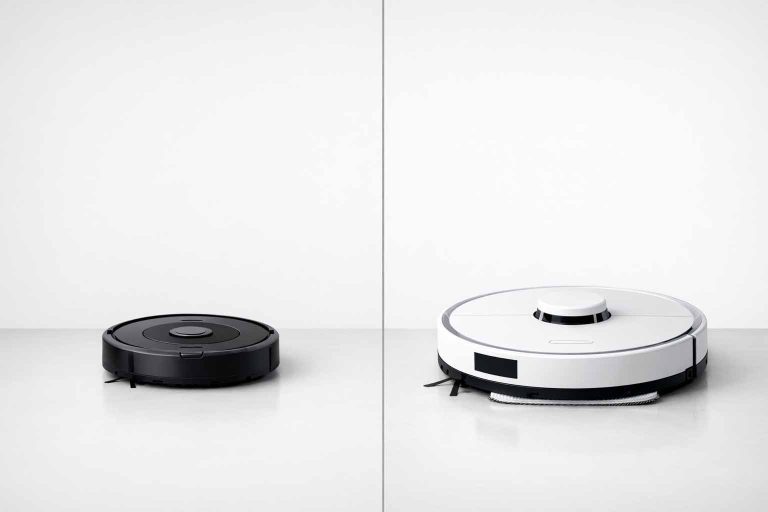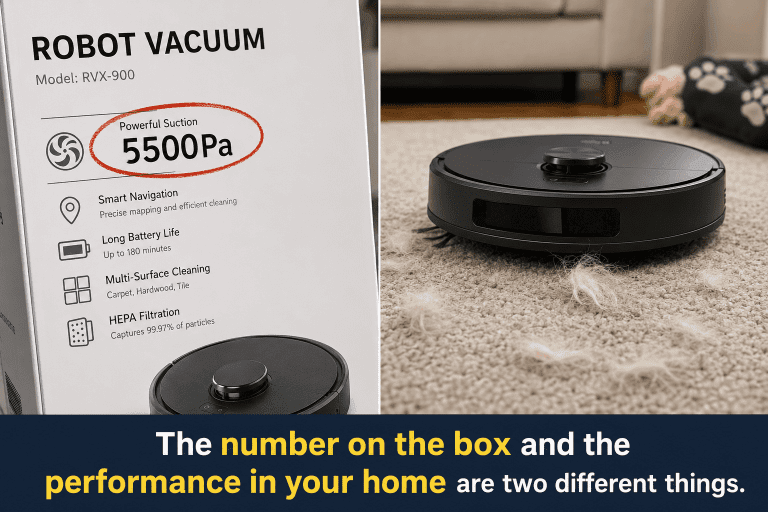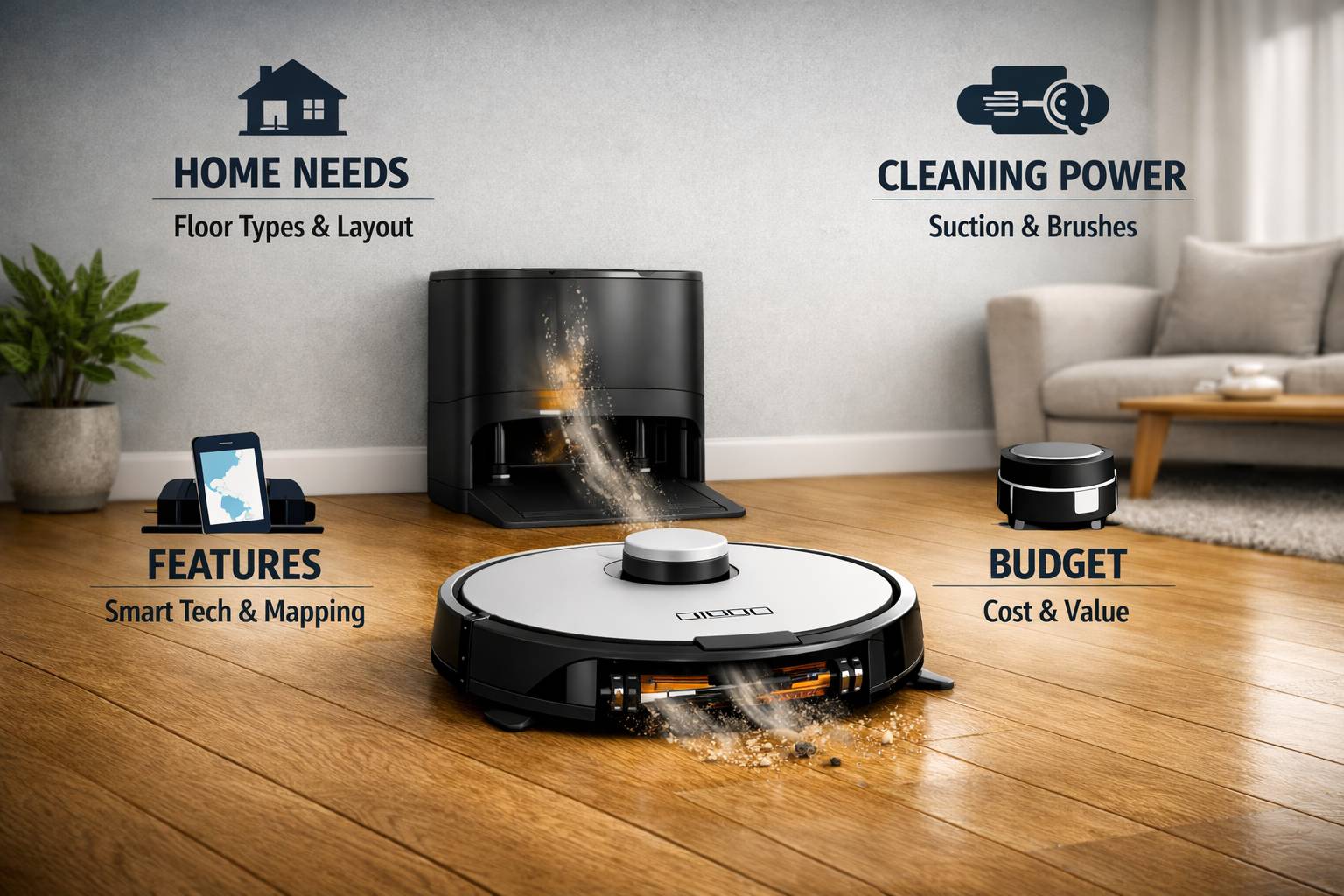
If you’ve ever stood in front of a wall of robot vacuums wondering what actually separates a $150 model from a $1,500 one, you’re not alone. Choosing a robot vacuum feels straightforward until you start reading specs. Suction power, LiDAR mapping, self-emptying bases, mop functions… it adds up fast. The good news is that most people don’t need everything. You just need the right things for your specific home.
This guide breaks down what actually matters when picking a robot vacuum, so you can skip the noise and find something that works.
Start With Your Floor Type
This is the first question worth asking, and a lot of buyers skip it. The floor surfaces in your home will shape almost every other decision.
If you have mostly hardwood, tile, or hard floors, nearly any robot vacuum will do a decent job. Suction requirements are lower, and you won’t need a model with aggressive carpet-boosting modes. Where it gets more specific is if you have high-pile or thick rugs. Some cheaper models struggle to climb onto them at all, and lighter robots can get stuck mid-clean.
For carpet, you want something with strong suction and ideally a rubber roller brush rather than bristles. Rubber brushes are less prone to tangling with pet hair and carpet fibres, which makes maintenance much easier in the long run.
Mixed floors? Most mid-range and premium models handle transitions between hard floors and carpet without any issues. Just check the maximum carpet height the robot supports before buying.
Consider Your Pets and Household
Pet hair changes the game. It wraps around brushes, clogs filters faster, and tends to accumulate in corners. If you have one or more pets that shed, it’s worth spending a little more to get a model designed with that in mind.
Look for robots that use tangle-free rubber brush rolls, high-efficiency filters—preferably HEPA or something close—and a big dustbin so you’re not always emptying it. Some models crank up the suction to really pull pet hair out of carpet, which is a huge help. Brands like Roborock, iRobot, and eufy all have pet-focused variants worth considering.
Allergy sufferers should also pay attention to filtration. A robot that picks up dust but releases fine particles back into the air isn’t doing you many favours.
Navigation and Mapping: Does It Actually Matter?
Yes, but not for everyone.
Basic robot vacuums use random or bump-and-turn navigation. They’ll cover most of your floor eventually, but the path is chaotic and they often miss spots or clean the same area repeatedly. For small apartments or single rooms, that’s usually fine.
For larger homes or multi-room layouts, systematic navigation makes a real difference. LiDAR-based mapping robots build a map of your home and clean in structured, efficient rows. You can also set no-go zones, schedule room-by-room cleaning, and track where the robot has been via an app.
If you have a home with furniture, cables on the floor, or pets that leave things around, obstacle avoidance is worth considering too. Entry-level obstacle avoidance works reasonably well, but more advanced systems (3D sensors, AI recognition) handle things like charging cables and pet waste with much less intervention.
Self-Emptying Bases and Mopping: Worth the Upgrade?
Self-emptying bases are one of the better quality-of-life upgrades you can get. Instead of emptying the robot’s dustbin every one or two runs, the base does it automatically. Depending on the bag or bin size, you might only need to empty it once a month or so.
The catch is cost. A robot with a self-emptying base can run anywhere from $400 to over $1,000. If hands-off convenience is important to you and the budget allows, it’s genuinely useful. If you don’t mind a quick daily empty, you can save significantly by going without.
Mopping features are worth thinking about carefully. Basic mopping robots just drag a damp cloth, which works on light dust on hard floors but won’t do much for sticky messes. Higher-end models with vibrating or rotating mop pads do a noticeably better job. Some high-end models go a step further and actually wash and dry the mop pad while they clean—pretty handy for keeping bacteria and smells at bay. Of course, this sort of feature is nice to have if you’ve got the budget, but most people will manage just fine without it.
Budget: What You Actually Get at Each Price Point
Under $200: You’re looking at basic models with bump-and-go navigation, smaller dustbins, and limited app features. Perfectly usable for small spaces or low-traffic homes, but don’t expect much in the way of smart mapping or scheduling.
$200 to $500: This is where mapping starts appearing more consistently, along with better suction and app control. A lot of people find a solid pick in this range. Brands like eufy, Tikom, and Yeedi offer good value here.
$500 to $1,000: Expect reliable LiDAR mapping, self-emptying options, stronger suction, and better obstacle avoidance. Roborock and Dreame produce well-regarded models in this bracket.
Over $1,000: You’re getting into robots with advanced mop washing stations, AI obstacle recognition, and multi-floor mapping. Worth it for large homes or people who genuinely want a set-and-forget solution.
Before You Buy: A Few Practical Things to Check
A couple of final things that often get overlooked:
Threshold and furniture clearance. Check the robot’s height and how high thresholds or transitions it can cross. Low-clearance sofas and beds can also be an issue if the robot can’t fit underneath to clean.
App and ecosystem. If smart home integration matters to you, check whether the robot works with Google Home, Amazon Alexa, or Apple HomeKit. Not all do.
Noise level. Robot vacuums vary quite a bit here. If you’re running it during work-from-home hours or at night, check reviews for noise feedback specifically.
Wrapping Up
Choosing a robot vacuum comes down to matching the right features to your actual home and habits. Start with your floor type and household needs, then factor in how much navigation intelligence and convenience features you want. From there, set a realistic budget and look at what’s available in that range.
Here’s the truth: you don’t have to buy the priciest robot vacuum out there to get something that actually helps. The key is finding one that fits your life.
If you’re ready to start comparing specific models, check out our robot vacuum reviews and use-case guides to narrow it down further.