If you’ve been shopping for an electric foot warmer lately, you’ve probably noticed the newer listings boasting “graphene heating technology” while the familiar ones just say carbon wire or carbon fiber. The price gap is real—sometimes significant—and the marketing language around graphene borders on breathless. So it’s fair to ask: is this actually a meaningful upgrade, or is it just a newer word for roughly the same thing?
The short answer is that graphene does heat differently, and in ways that matter for a foot warmer specifically. But whether that difference is worth paying for depends a lot on how you plan to use it.
What’s Actually Inside Each Type
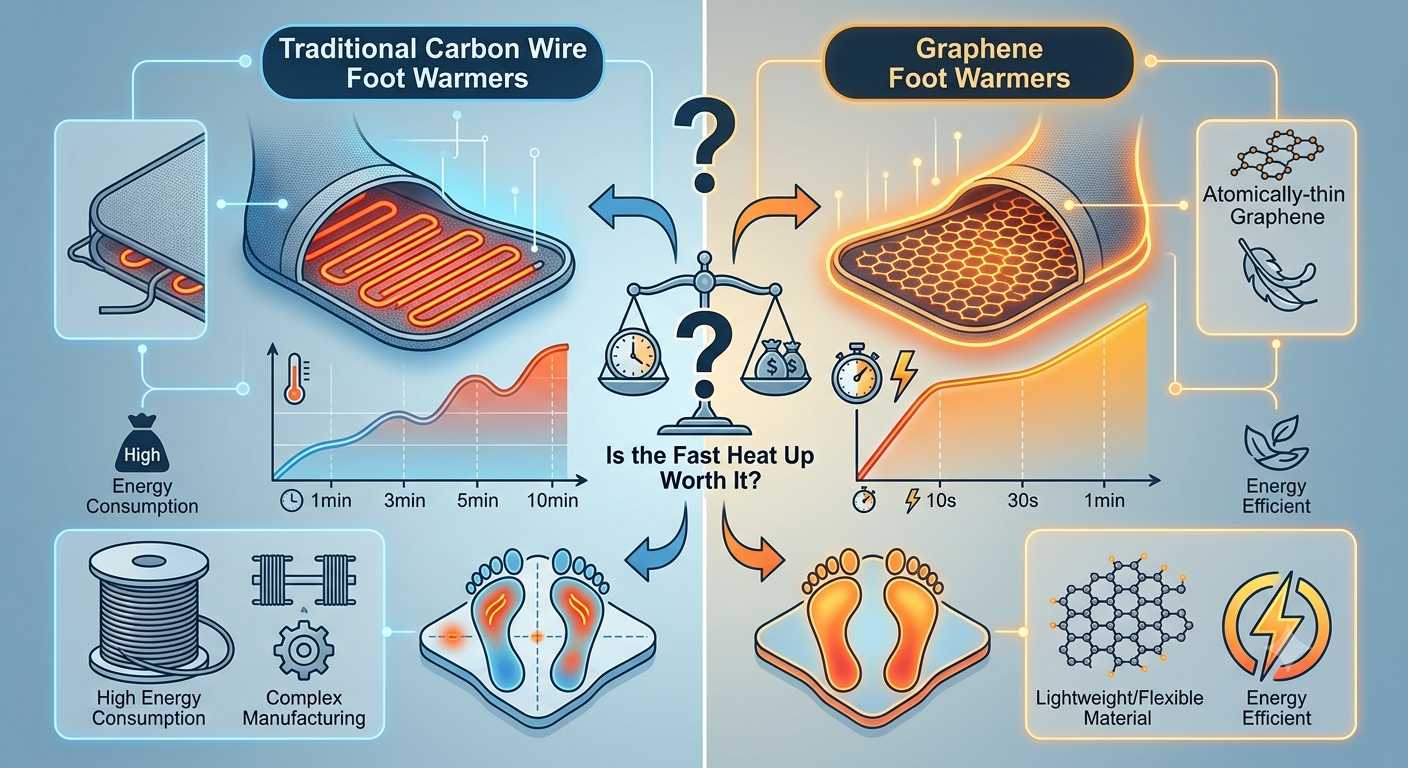
Traditional carbon wire foot warmers work through electrical resistance. When current passes through the wire—typically a coiled or zigzagged nichrome or carbon-based wire—heat builds up and radiates outward. The wire itself is the heat source, and warmth moves from those wire points into the surrounding material and then to your feet. It works, and it’s been working reliably for years.
Graphene heating elements are structured differently. Instead of wires, graphene foot warmers use an ultra-thin conductive film—usually under 0.3mm thick—made from layers of carbon atoms arranged in a hexagonal lattice. When current runs through this film, electrons flow across the entire surface area rather than concentrating along a wire path. The result is heat that generates across a broader surface simultaneously rather than radiating outward from individual wire points.
It’s a meaningful distinction once you understand it: wire heats in lines, film heats in planes.
Heat-Up Speed: Where Graphene Pulls Ahead
This is the most obvious practical difference, and the numbers are notable. Graphene heating elements reach operational temperature in around 5 to 10 seconds. Carbon fiber wire elements typically take 10 to 20 seconds, and traditional resistance wire heating can take 30 seconds or more to feel warm.
For a foot warmer you’re reaching for on a cold morning, that difference is genuinely noticeable. Sitting down at your desk and feeling warmth almost immediately versus waiting half a minute is a real quality-of-life gap, not just a spec sheet number.
Graphene also tends to be more energy-efficient once it’s running. Because the film converts electricity to heat across its whole surface rather than losing energy as the heat travels outward from wires, graphene systems typically draw around 20 to 30 percent less power to maintain the same temperature. Over long sessions at a desk or in a home office, that can add up to meaningful battery life gains or lower electricity draw if you’re running it plugged in.
Heat Distribution: Even vs. Uneven
This is probably the part that matters most for everyday comfort, and it’s where graphene has a structural advantage.
Carbon wire and carbon fiber heating elements create what’s sometimes described as a grid pattern—heat radiates from the wire paths, so the areas directly above the wire feel warmer than the spaces between them. Most of the time this difference is subtle and your feet adjust fine. But on colder settings or with thinner insulation between you and the element, you can occasionally feel those warm lines.
Graphene film heats uniformly across its surface area, with reported temperature variation of around plus or minus 2 degrees Celsius across the heating zone. For a foot warmer, that means consistent warmth from heel to toe without patches of varying intensity. Fewer hot spots also means a reduced risk of discomfort from prolonged contact with a single concentrated heat point.
The Price Gap and What You’re Actually Paying For
Here’s where things get more complicated. At the component level, heating wire costs a few dollars per unit, carbon fiber elements run roughly $5 to $10, and graphene film starts around $15 or more before any other manufacturing costs. That difference flows through to the retail price, and graphene foot warmers typically sit at a higher price point than comparable carbon wire models.
Whether that’s worth it comes down to use case. A few honest considerations:
If you use a foot warmer for short bursts — at a standing desk, slipping it on for an hour during evening TV — the faster heat-up time is a real convenience perk you’ll notice every session.
If you run it for long stretches — say, a full workday at a desk — the energy efficiency and even heat distribution matter more than the warm-up speed alone, and graphene holds an advantage there too.
If budget is the main concern, a quality carbon wire foot warmer is not a compromise product. The warmth is real, and for many people the heat-up difference isn’t something they’d notice once the habit forms. Carbon fiber models in particular heat up reasonably quickly and are often more durable across wash cycles than graphene film, which can degrade faster with repeated washing.
One thing worth checking before buying either type: look at whether the cover is removable and machine washable independently of the heating element. Some graphene models protect the film by keeping it sealed away from water, which can make care simpler.
Which One Should You Get?
Graphene makes genuine sense if you want the fastest possible heat-up, the most even warmth distribution, and don’t mind paying a bit more for it. It’s the right pick for anyone who finds themselves impatiently waiting for a cold foot warmer to kick in, or who notices uneven warmth with their current model.
Carbon wire and carbon fiber foot warmers remain a practical, well-established choice. They heat up fast enough for most people, they’re widely available at various price points, and the technology is mature enough that quality control is generally reliable.
The science behind graphene is real, and the performance differences are measurable. Whether those differences translate into a meaningfully better experience for you specifically is the question worth sitting with before spending more.
References and Resources
- Venustas Heated Apparel – Carbon Fiber vs. Graphene Heating Elements: https://venustas.com/blogs/news/carbon-fiber-vs-graphene-which-heating-element-is-better
- Dr. Warm Heated – Best Heating Element for Custom Apparel (Graphene vs Carbon Fiber vs Wire): https://drwarmheated.com/blog/what-is-the-best-heating-element-for-custom-apparel/
- Dr. Warm Heated – Carbon Fiber vs Heating Film vs Heating Wire Comparison: https://drwarmheated.com/blog/carbon-fiber-vs-heating-film-vs-heating-wire-which-heating-element-is-best-for-heated-clothing/
- GoKozy Wear – Carbon Fiber vs Graphene Heating Films: https://www.gokozywear.com/blogs/news/carbon-fiber-vs-graphene-heating-films
- Safwear – Graphene vs. Carbon Fiber Heated Gear (Honest Guide): https://www.safwear.ai/blog/graphene-vs-carbon-fiber-heated-gear-the-brutally-honest-guide-to-staying-warm-on-the-job
- Fancy Warm – Electric Wire Heat, Carbon Fiber Heat, and Graphene Heat Showdown: https://www.fancywarm.com/post/electric-wire-heat-carbon-fiber-heat-and-graphene-heat-showdown-which-one-is-your-best-winter-com
- GrapheneHeat – Graphene Heating Applications in the Clothing Industry: https://grapheneheat.com/blogs/news/graphene-heating-applications-in-the-clothing-industry-a-comparative-advantage-over-other-heating-materials
- Lanaform – Graphene Foot Warmer (product reference): https://lanaform.com/en/graphene-foot-warmer-rechargeable-electric-foot-warmer.html