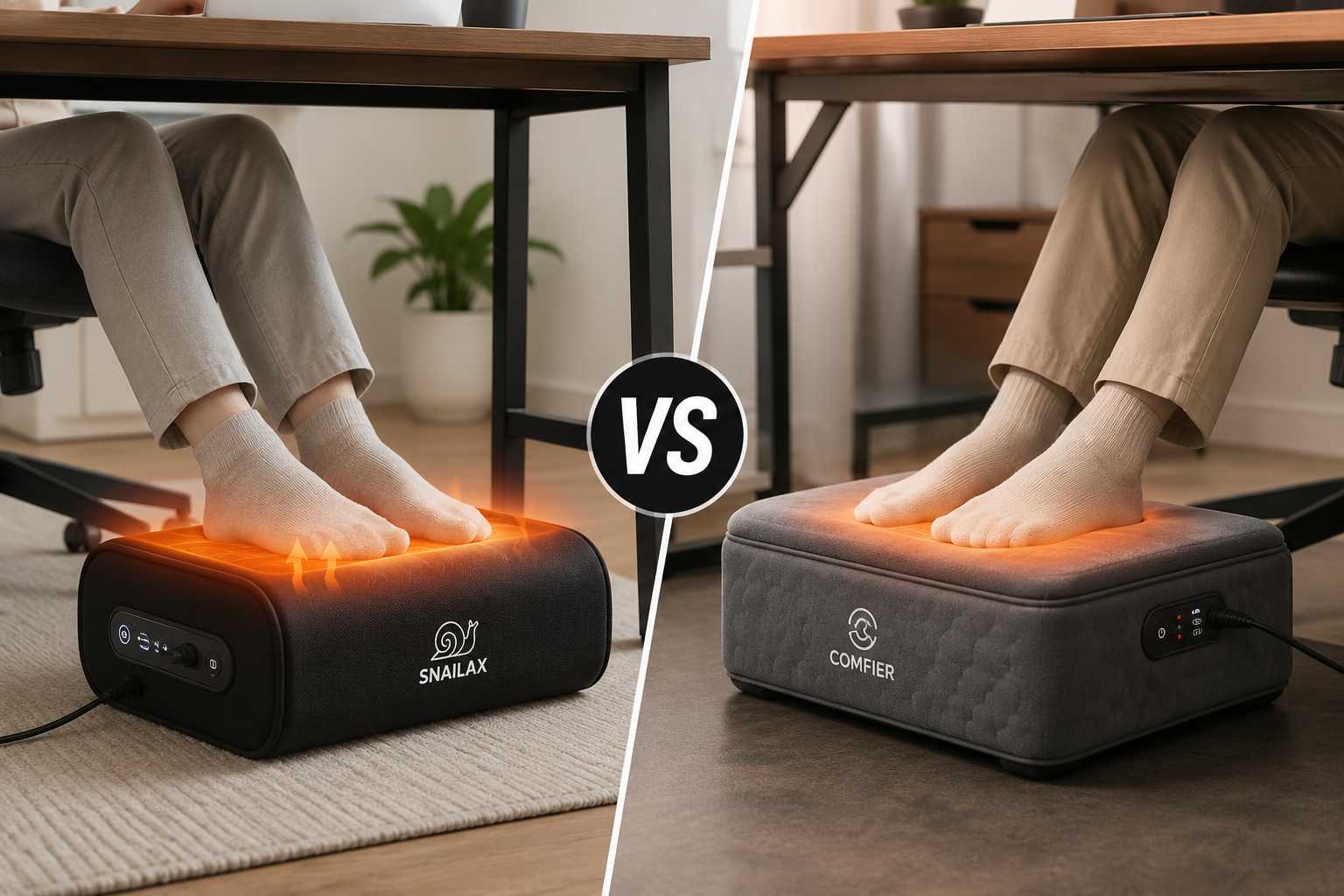
Cold feet at your desk is a real productivity killer. Once you have experienced that low-level chill creeping in halfway through the afternoon, a heated footrest starts looking less like a luxury and more like a legitimate work accessory. Two names keep coming up in this space: Snailax and Comfier. Both make heated, vibrating desk footrests at a similar price point, and on the surface they look almost identical. But the differences add up quickly once you get into the details.
This guide breaks down how Snailax and Comfier stack up across build quality, heat performance, control design, height adjustment, and what actually happens if something goes wrong down the track.
Build Quality and Materials
Both brands use memory foam as their core padding material, and both cover that foam in a sherpa or plush outer layer you can remove and wash. That much is consistent.
Where they differ slightly is in how that foam is constructed. Comfier uses what they describe as high-density polyurethane memory foam designed to rebound to its original shape after use, which matters because a footrest that compresses flat over a few months is not doing much for posture or comfort. Snailax also uses memory foam, and their double-layer design adds some structural flexibility since each layer can be repositioned independently.
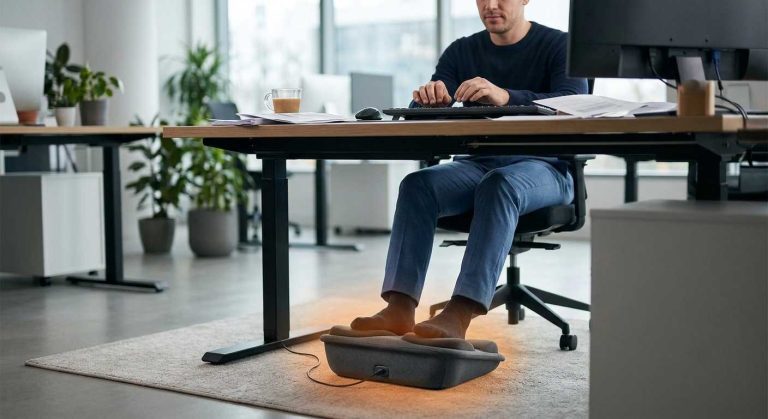
The Comfier 2026 model (CF-5502) does something different with its heating element. It uses graphene heating fabric with far-infrared technology rather than a standard resistive heating wire. Graphene heats faster and distributes warmth more evenly across the surface, which in practical terms means less hot-spot concentration in one area. The Snailax models use a more conventional heating approach, which works fine but does not heat as quickly.
Both brands have a non-slip base to stop the footrest sliding around on hard floors, and both covers are machine washable. For daily desk use, either holds up reasonably well.
Heat Settings and How They Perform
Heat is the main selling point for both, and the specs here are actually quite different.
Snailax offers three heat levels across most of its current models, with on-unit touch buttons to cycle through them. Some models also include three customizable timer settings so the heat shuts off automatically after a set duration.
Comfier’s CF-5420 offers two defined heat levels at 45°C (low) and 55°C (high), with three timer options of 1, 2, or 4 hours. The 2026 graphene model reaches working temperature in around 60 seconds and offers three heat modes. That fast warm-up is a genuine practical advantage if you tend to sit down and immediately want warmth rather than waiting a few minutes for the footrest to reach temperature.
For a desk setup, the Comfier’s labeled temperature ranges give you a clearer sense of what you are actually getting. Snailax’s “low, medium, high” approach is less specific about actual temperatures, which is a minor point but worth noting if you run cold and want to know you are hitting a particular warmth threshold.
Both brands include a 15-minute auto shut-off on the vibration massage function as a safety feature. Heat timers give additional control over how long the warmth runs unattended.
Control Design — Buttons vs. Panels
This is where the two brands take noticeably different approaches, and it is worth thinking about carefully because you will be interacting with these controls dozens of times a week.
Snailax uses on-unit toe-touch buttons built into the footrest surface or accessible from the edge of the unit. The appeal is that you never need to dig around for a separate remote or reach over to a panel somewhere. You tap with your foot or tap the side of the unit and cycle through settings. For most people, this is enough.
Comfier’s heated footrest models use a wired control panel that sits near the footrest and lets you adjust heat, vibration, and timer settings from a small handheld panel. Some users find this more convenient because you can adjust settings without moving your feet off the rest at all. Others find a dangling cord slightly annoying to manage under a desk.
Neither approach is objectively better. If you change settings infrequently, the Snailax button setup works fine. If you like being able to tweak heat and vibration separately without any foot movement, the Comfier panel setup offers a bit more flexibility.
Height Adjustment
Posture support is the other major function of a desk footrest, and this is where height range matters. Getting your feet flat at the right angle for your chair and desk height is the whole point.
Snailax’s double-layer design gives you two height positions by reconfiguring the two foam layers. Most models offer two to three height options depending on the specific model you select. The layer system is simple enough to adjust but does require lifting and repositioning the unit, which is not something you would do mid-session.
Comfier offers three height settings on the CF-5420 using a removable bottom layer and a foldable design. The CF-5502 (the 2026 graphene model) works with two height positions but frames it as a universal fit for a range of user heights and desk setups.
If your chair height varies significantly or you share a desk setup with someone of a different height, Comfier’s three-setting option gives slightly more flexibility. For solo use at a fixed desk, either brand’s height range is adequate.
Warranty and After-Sales Support
This is an area where the two brands have meaningful differences, and it is probably underweighted when people are choosing between them.
Comfier offers a 12-month standard warranty from the date of purchase. If you register your product within 60 days of buying it, that extends to two years at no extra cost. Within the first 90 days, defective products are eligible for repair, replacement, or a full refund. After that and within the first year, you can get a replacement but not a refund. The process requires submitting a short video of the fault and emailing their support team, with a 1–2 business day review window.
Snailax states a 24-month warranty on products purchased through their own store. However, customer reviews across Trustpilot and Amazon suggest that warranty claims can be slow, with some customers reporting delays in responses and difficulty getting replacements processed. The official policy is reasonable on paper, but real-world execution appears inconsistent based on available feedback.
If after-sales confidence matters to you, Comfier’s structured warranty registration process and documented claim steps give a clearer picture of what to expect. Extended two-year coverage through registration is also a tangible benefit that Snailax does not match on the direct-purchase warranty side.
Quick Comparison at a Glance
| Feature | Snailax | Comfier |
|---|---|---|
| Heating technology | Standard resistive | Graphene far-infrared (2026 model) |
| Heat levels | 3 | 2–3 depending on model |
| Heat warm-up time | Standard | ~60 seconds (graphene model) |
| Control type | On-unit toe-touch buttons | Wired handheld panel |
| Height positions | 2–3 | 2–3 |
| Vibration modes | 3 | 3 |
| Auto shut-off (vibration) | 15 minutes | 15 minutes |
| Warranty (standard) | 24 months (own store) | 12 months |
| Warranty (extended) | Not clearly offered | 2 years with registration |
| Cover washability | Yes | Yes |
Conclusion: Which One Should You Pick?
If fast heat warm-up and a more clinical approach to temperature control appeals to you, the Comfier 2026 graphene model earns its price through genuine tech differentiation. The structured warranty process and free two-year extension through registration also add real value, especially for something you plan to use daily for years.
If you prefer a simpler, button-based control setup and do not want to manage a wired panel cord under your desk, Snailax keeps things clean. Their three heat levels and straightforward dual-layer design work well for most people who just want warmth and a bit of vibration without fuss.
Both are solid options for a home or home office desk setup. The honest answer is that the Comfier has a slight edge on heating technology and warranty structure, while Snailax keeps the user experience more streamlined. Either way, cold feet at your desk should be a problem of the past.
References and Resources
- Comfier CF-5420 Heated Footrest — Official Product Page: https://www.comfier.com/products/comfier-foot-rest-under-desk-at-work-with-heat-vibration-foot-heater-foot-warmer-3-height-under-desk-foot-rest-for-office-chair-gaming-chair-footstool-ergonomic-heated-footrest-computer-desk-use-cf-5420
- Comfier 2026 CF-5502 Graphene Footrest — Amazon Product Listing: https://www.amazon.com/Comfier-Graphene-Ergonomic-Heights-Vibration/dp/B0G58JN1NT
- Comfier Warranty and Return Policy (Official): https://www.comfier.com/pages/warranty-policy
- Comfier Extended Warranty Registration: https://www.comfier.com/pages/warranty-registration
- Snailax Heated Footrest (Model 535) — Official Product Page: https://www.snailax.com/products/memory-foam-vibration-foot-massager-535
- Snailax Heated Footrest — Amazon Product Listing: https://www.amazon.com/Snailax-Heated-Vibration-Massage-Ergonomic/dp/B0GS55T624
- Snailax Customer Reviews — Trustpilot: https://www.trustpilot.com/review/www.snailax.com
- Pain Free Working — Snailax Heated Foot Stool Review: https://www.painfreeworking.com/snailax-heated-ergonomic-foot-stool-review/